
Greeneria uvicola
Greeneria uvicola
Description
How to identify
Greeneria uvicola is an imperfect fungus of the order Melanconiales, recognized as the primary causative agent of bitter rot disease in grapevines.
The pathogen primarily affects the generative parts of the plant, developing via conidial sporulation, which is often mistaken for other types of grape rot.
Systematically, the fungus belongs to the kingdom Fungi and the class Ascomycetes (in its teleomorph stage Guignardia bidwellii f. euvitis), though it is commonly classified by its anamorph in agronomy.
For laboratory identification, microscopic analysis of infected berries reveals characteristic dark fungal fruiting bodies known as acervuli.
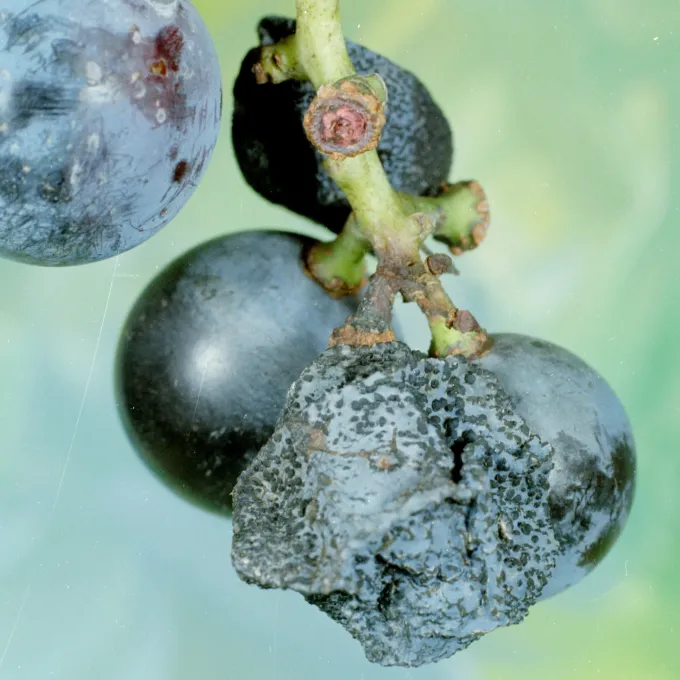
Visually, the fungus is easily identified by the mass discharge of spores in mucous droplets or chains, which cover the berry surface under conditions of high humidity.
What it damages
The primary host for this pathogen is the common grapevine (Vitis vinifera) and its various interspecific hybrids.
The disease affects berries at different stages of ripening, from initial fruit set through full maturity, leading to substantial yield losses.
Beyond berries, the fungus can infect the grape rachis, disrupting nutrient flow and causing premature drying of the clusters.
Infection may spread to shoots, resulting in necrotic spots that weaken the overall condition of the vine before the onset of winter.
The economic impact is significant due to the dramatic degradation of wine quality; the fungus imparts a distinctive bitter flavor to the must, rendering the harvest unsuitable for vinification.
When it appears
Active development of the pathogen is typically observed during the summer months when warm and humid weather patterns facilitate rapid spore dispersal.
The incubation period shortens under conditions of high temperatures (25–30°C) combined with frequent rainfall, which keeps the berry surface wet.
The pathogen overwinters in soil and on infected plant debris, as well as within dormant canes, serving as the source of primary inoculum in the spring.
The most critical period for disease development occurs during the veraison stage, when berry tissues become increasingly susceptible to hyphal penetration.
As the season ends, the fungus enters a resting stage, forming resilient structures that ensure survival until the following growing season.
Signs of infestation
Initial signs of infection appear as small brown spots, which expand rapidly to encompass the entire surface of the berry.
Infected berries quickly wrinkle and turn a dark brown or black color, with numerous small black bumps appearing on the skin.
Bitter rot derives its name from the characteristic change in flavor of the affected tissue, which becomes intensely bitter and unpleasant.
During humid weather, light-colored or yellowish spore tendrils emerge from the black bumps, serving as the primary source for secondary infection of healthy berries within the cluster.
- Darkening and deformation of berries.
- Formation of black acervuli on the skin.
- Spore discharge in the form of exudate.
- Complete shriveling and drying of clusters.
Control measures
The cornerstone of management is cultural control: the strict removal and destruction of all infected vine parts throughout the growing season.
It is essential to maintain proper canopy management and timely pruning to improve cluster aeration, thereby reducing the humidity levels within the vine canopy.
Chemical control involves the application of broad-spectrum fungicides known to be effective against various types of grape rots.
Preventive spraying should be conducted during critical developmental stages, starting immediately after flowering and continuing until the berries close in the cluster.
Use of copper-based preparations or systemic fungicides is recommended, provided that application frequency and pre-harvest intervals are strictly observed.
Causes diseases · 1
Discussion
No discussions yet — be the first.