
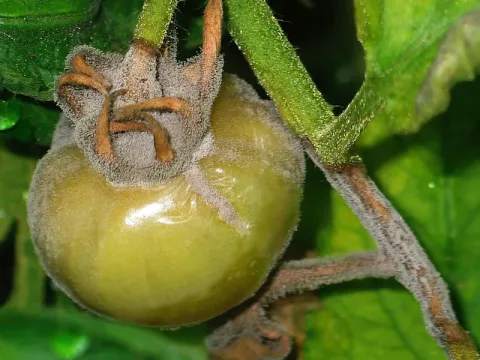
Gray mold
Botryotinia fuckelinana
Gray mold, caused by the fungus Botryotinia fuckeliana (anamorph Botrytis cinerea), is a devastating phytopathogen belonging to the kingdom Fungi, phylum Ascomycota, and genus Botryotinia. It is one of the most economically significant pathogens in agriculture worldwide.
What the section contains
Gray mold
In the field, the pathogen is most often observed in its asexual stage. The fungus produces a dense, grayish, fuzzy mass of mycelium and conidiophores that release vast numbers of conidia, which are easily disseminated by wind, splashing rain, and insect vectors.
The fungus survives harsh conditions as sclerotia, which are hard, black, compact mycelial masses. These sclerotia remain viable in the soil, on plant debris, or on overwintering crops for several years, providing the source for primary infection in the spring.
The pathogen is a facultative parasite, meaning it can survive as a saprotroph on dead organic matter. This capability allows it to persist in the environment and jump onto healthy living tissues whenever environmental conditions become favorable.
Its extremely wide host range, encompassing hundreds of different plant species, makes Botryotinia fuckeliana a ubiquitous threat that can spread between wild weeds and cultivated fields with ease.
Gray mold infests over 200 plant species, including grapes, strawberries, tomatoes, onions, and sunflower. The pathogen can attack virtually any part of the plant, including leaves, stems, flowers, and fruits.
In vineyards, the infection leads to "noble rot" in some cases, but more frequently results in severe gray rot, which compromises berry integrity and ruins wine quality with undesirable moldy notes.
Strawberry crops are particularly susceptible, as the fungus quickly invades ripening berries, turning them into soft, decayed mush covered in gray mycelium, rendering them completely unmarketable.
For greenhouse vegetable crops like tomatoes and cucumbers, gray mold often targets stem bases, causing girdling lesions that interrupt water and nutrient transport, leading to the collapse and death of entire plants.
Post-harvest, the disease is a major cause of storage losses, where the fungus spreads through direct contact between healthy and infected produce, often causing significant waste in transit and retail storage.
Gray mold thrives in moderate temperatures, generally between +15 °C and +25 °C, and requires high relative humidity (above 80-90%) for the germination of spores and penetration of host tissues.
In greenhouse settings, poor ventilation and high humidity levels can create perfect conditions for rapid pathogen colonization, allowing the fungus to complete its life cycle within just a few days.
Extended periods of rainfall, heavy dew, or fog are critical drivers of infection. Surface moisture on leaves and fruits provides the necessary environment for the pathogen to germinate and infect the plant.
While high temperatures and dry conditions can inhibit the pathogen's activity, microclimates within dense foliage can retain enough moisture for the disease to persist and cause localized damage even in drier summers.
In storage environments, the disease can remain active throughout the entire storage period if temperature control and air circulation are not strictly managed to prevent condensation on the product.
The first clinical sign of infection is the development of water-soaked, brownish spots on affected tissues. These spots expand rapidly under humid conditions, causing tissue softening and necrosis.
As the infection progresses, the classic sign of "gray mold" appears: a dense, dusty, gray-colored fungal growth consisting of conidiophores and spores that spreads across the necrotic area.
Stem infections typically manifest as elongated, discolored lesions that eventually girdle the stem, leading to the sudden wilting and flagging of foliage above the point of infection.
Floral tissues are highly sensitive; infection at the blossom stage leads to flower blighting and premature drop, which significantly reduces the potential fruit set and overall yield.
In the final stages, infected fruits often dry out, shrivel, and become mummified, forming small, hard, black sclerotia on the surface, which serve as the overwintering structure for the next season.
Management of gray mold requires an integrated approach that focuses on reducing inoculum levels and minimizing moisture on plant surfaces.
- Strict sanitation by removing and destroying all infected plant parts to prevent the buildup of sclerotia in the soil.
- Ensuring adequate plant spacing and pruning to promote airflow and light penetration, which helps foliage dry quickly after rain.
- Maintaining proper greenhouse environmental control, including ventilation and irrigation management to avoid leaf wetness.
- Avoiding excessive nitrogen fertilization, which encourages lush, succulent growth that is more susceptible to fungal penetration.
- Using biological control agents such as Trichoderma species and timely application of chemical fungicides during vulnerable growth stages to suppress spore germination.