
Bipolaris leaf spot
Bipolaris zeicola
The causal agent of this disease is the fungus Bipolaris zeicola (syn. Cochliobolus carbonum), which belongs to the kingdom Fungi. It is a necrotrophic pathogen that infects various tissues of the maize plant.
What the section contains
Bipolaris leaf spot
The fungus produces conidia, which serve as the primary inoculum for spreading the disease throughout the field during the growing season.
Systematically, it is grouped with helminthosporium-like leaf spot pathogens, known for their ability to thrive in various moisture-rich environments.
The life cycle includes both asexual spore production and sexual reproduction, which enhances the fungus's ability to survive in crop residues during winter.
Identification is confirmed through microscopic analysis of the conidia, which exhibit specific morphological traits distinguishing them from other Bipolaris species.
The primary host for Bipolaris zeicola is maize (Zea mays), including both field and sweet corn varieties. The pathogen is highly destructive to leaves and reproductive organs.
Infection results in leaf necrosis, which drastically reduces photosynthetic capacity and causes premature senescence of the canopy.
Stalk infection can lead to lodging and structural weakness of the plants, increasing the risk of mechanical damage and harvest losses.
The fungus can also infect the ear, causing grain rot, which severely impacts the quality and market value of the harvested maize.
Yield losses can be significant, especially under heavy infection pressure or when weather conditions favor rapid fungal development.
The disease initiates from primary inoculum present in crop residues or contaminated seeds at the beginning of the growing season.
The spread of the pathogen intensifies during the reproductive stages, particularly as the plant approaches the tasseling and silking phases.
Moderate temperatures ranging from 22°C to 28°C, combined with high humidity, create optimal conditions for the germination and spread of spores.
Environmental factors like heavy morning dews, frequent rainfall, or persistent fogs are critical for the development of severe disease outbreaks.
As the season progresses, the concentration of airborne spores increases, leading to a secondary spread that affects healthy leaves and ears.
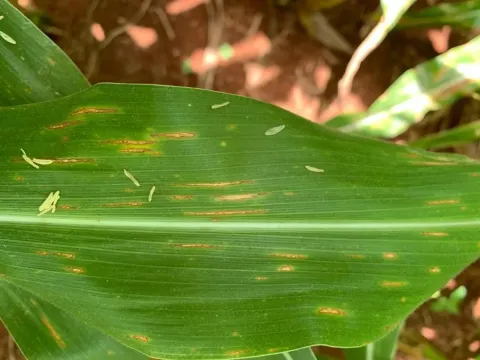
Symptoms appear as small, chlorotic spots that gradually expand into oval or elongated necrotic lesions on the leaves.
These spots often exhibit a brownish color surrounded by a characteristic light-colored or yellowish halo, which is a symptom of fungal toxin secretion.
Under conditions of high humidity, an olive-black fuzzy layer—the fungal conidiophores—becomes visible on the surface of the infected areas.
When the ears are affected, the fungus colonizes the kernels, often resulting in visible mycelial growth and darkening of the grain surface.
Advanced infection causes the leaves to curl and dry up, which can lead to the death of large portions of the leaf area before grain filling is complete.
Cultural practices are essential for management, starting with strict crop rotation to reduce the pathogen population in the soil.
Deep plowing and efficient management of maize stalks are necessary to bury the crop residues where the fungus overwintering occurs.
Selecting and planting genetically resistant maize hybrids is the most sustainable and efficient strategy for avoiding major yield losses.
Chemical control involving systemic fungicides applied at the onset of symptoms can help reduce the severity of the infection.
- Use certified, disease-free seed treated with high-quality fungicides.
- Maintain optimal nutrient balance, particularly ensuring adequate potassium levels to enhance plant immunity.
- Control volunteer corn plants to prevent early-season infection cycles.
- Time seeding to minimize the susceptibility of the crop during high-risk environmental windows.