
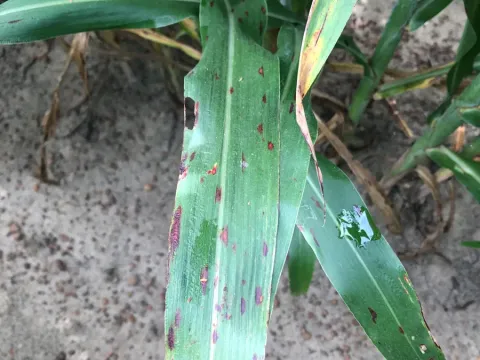
Bipolaris sorghicola
Bipolaris sorghicola
Bipolaris sorghicola is a fungal pathogen belonging to the kingdom Fungi, phylum Ascomycota. It is the causal agent of gray leaf spot in sorghum, a disease that can significantly impact crop health globally.
What the section contains
Bipolaris sorghicola
The fungus produces septate mycelium and specialized conidiophores. These structures bear multi-celled, spindle-shaped conidia, which are the primary units for the dispersal of the pathogen throughout a field.
Biologically, the pathogen persists as mycelium or conidia on infected crop debris, in the soil, and on the surface of seeds. It transitions from a dormant state to an active state when environmental conditions become suitable.
The taxonomic classification places it within the Pleosporales order, often associated with the teleomorph stage Cochliobolus sorghicola. It is a specialized pathogen that exhibits high host specificity for sorghum species.
Identification requires careful examination of leaf lesions. Laboratory confirmation usually involves culturing the fungus on specific media to observe the morphological characteristics of the conidia, which are distinct for this species.
The disease primarily affects various types of sorghum, including grain sorghum, sweet sorghum, and Sudan grass. It causes significant physiological stress to the host plants during their vegetative growth stages.
The destruction of leaf tissue leads to a reduction in the photosynthetic area, which directly impairs the plant's ability to produce energy. This results in poor grain development and reduced biomass yield.
In cases of severe infection, the fungus can progress to the stems, weakening the stalk structure. This physical damage often results in lodging, making it difficult to harvest the crop effectively and increasing grain loss.
The quality of the harvested grain and fodder is significantly degraded by the presence of the pathogen. Infected plants often produce smaller, shriveled grains with lower nutritional value, affecting the overall market grade.
Economic damage is exacerbated in regions with high humidity. Total yield losses can be substantial, making it necessary for farmers to implement proactive disease management strategies throughout the growing season.
The life cycle of Bipolaris sorghicola is closely tied to seasonal moisture and temperature. The disease typically emerges during the vegetative growth phase when humidity levels are consistently high.
Optimal temperatures for infection range from 20°C to 28°C. During these conditions, conidia germinate rapidly upon contact with the leaf surface, forming germ tubes that penetrate plant tissues.
The disease cycle can repeat multiple times during a single growing season. Frequent rain, heavy dew, and high atmospheric humidity promote the continuous production and dispersal of spores, potentially leading to epidemic levels.
Drought conditions temporarily arrest the disease progression, as the pathogen becomes less active. However, it remains viable and can quickly resume development once favorable conditions return, particularly in the presence of leaf moisture.
As the season comes to a close, the fungus prepares for survival by entering the crop residues. Managing these residues after harvest is a crucial step in breaking the disease cycle for the upcoming year.
Initial symptoms include small, water-soaked spots on the leaves. As the infection progresses, these spots expand into characteristic oval or spindle-shaped lesions, often with a gray or tan center and a dark border.
Under conditions of high humidity, an olive-black velvety mold develops on the surface of the lesions. This mold consists of massive amounts of conidia, which serve as the inoculum for spreading the disease.
Lesions often merge to form large, necrotic patches that cover significant areas of the leaf. This leads to yellowing (chlorosis) and subsequent tissue death, which often starts from the lower leaves and moves upward.
In addition to leaf symptoms, the pathogen may cause dark brown or blackish discolorations on the stem and panicle. These infections are particularly dangerous as they can affect the plant's overall structural integrity.
The presence of a yellow or reddish-brown halo around the spots is a common sign, reflecting the plant's attempt to restrict the fungus's movement. These visual cues are essential for early field diagnosis.
Integrated disease management is essential. The primary strategy involves the use of resistant or tolerant sorghum hybrids, which significantly decrease the severity of leaf spot outbreaks in the field.
Cultural practices such as crop rotation, typically with a three-year break between sorghum plantings, are highly effective in reducing the pathogen load. Deep plowing of crop residues helps to accelerate decay and destroy overwintering structures.
Seed treatments with broad-spectrum fungicides are recommended to prevent early-season infections. Ensuring that the planting material is free from pathogens is a critical first line of defense for the crop.
Foliar application of fungicides may be necessary during the growing season if weather conditions favor the rapid spread of the disease. Systemic products are usually preferred to provide long-lasting protection to the developing leaves.
Maintaining adequate plant spacing to promote air circulation can help reduce humidity around the canopy, creating a less favorable environment for fungal spore germination and disease establishment.