
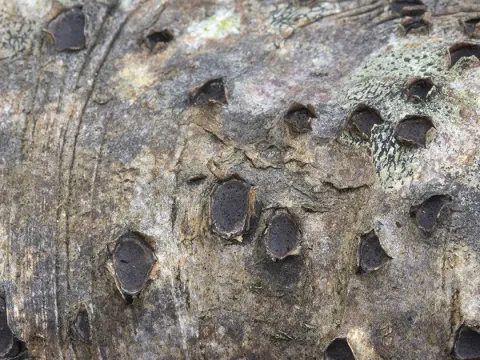
Biscogniauxia marginata
Biscogniauxia marginata
Biscogniauxia marginata is an ascomycete fungus within the Hypoxylaceae family. It primarily functions as a wood-inhabiting pathogen that colonizes the bark and cambium layers of various woody plant species.
What the section contains
Biscogniauxia marginata
The fungus is distinguished by its macroscopic fruiting structures, known as stromata. These are typically carbonaceous, black, and have a distinct, raised margin, appearing as small crust-like patches breaking through the host's bark.
The life cycle involves the production of perithecia embedded within the stromata. These structures release ascospores, which are wind-dispersed and often washed by rain, facilitating the infection of new host tissues during periods of high humidity.
As a facultative pathogen, it often targets trees already suffering from environmental stress, such as drought, sunscald, or mechanical injury. It progresses from saprophytic colonization of dead bark to aggressive necrotic growth.
Diagnosis requires careful observation of the fruiting bodies on the bark. In laboratory settings, mycologists analyze spore morphology and cultural characteristics on agar media to confirm the presence of this specific species.
This fungus primarily affects a range of deciduous trees, including members of the Rosaceae family. It is known to cause significant damage to fruit trees, where it targets branches and trunks, leading to bark necrosis.
The pathogen disrupts the vascular system by destroying the cambium and phloem layers. This blockage prevents the movement of water and nutrients, resulting in rapid dieback of distal parts of the tree canopy.
When the infection circles a branch or a trunk, it causes a girdling effect. This prevents the flow of photosynthates downwards, eventually leading to the death of the section above the girdled area.
In forest environments, the fungus contributes to wood decay and increased fragility of branches. This poses safety risks in public spaces and reduces the structural integrity and economic value of the wood.
The damage is cumulative; repeated infections weaken the tree's defensive systems, making it increasingly susceptible to other secondary pathogens and wood-boring insects.
Initial signs of infestation appear as discolored, sunken areas on the bark. The affected bark often dries out and begins to crack, signaling the death of the underlying tissue.
As the pathogen matures, carbonized black stromata emerge through the bark surface. These structures are often clearly defined by a thin margin, which remains as a remnant of the host's periderm, giving it a distinctive look.
Peeling back the dead bark reveals a creamy to white mycelial mat directly beneath. This fungal mass actively invades the xylem and phloem, causing the tissue to lose its natural texture and color.
Foliage symptoms include chlorosis and premature wilting. Often, branches will die suddenly during the summer heat, as the compromised vascular system can no longer meet the plant's transpiration requirements.
During the dormant season, the black stromata become most visible, making it an ideal time to perform inspections and identify heavily infested trees or branches within the orchard or forest stand.
Sanitation is the most effective management strategy. All infected branches must be pruned back to healthy wood, ensuring that no signs of internal discoloration or mycelial presence remain on the cut surface.
All removed material must be destroyed, preferably by burning, to prevent the release of spores that could infect healthy neighboring trees. Never leave infested wood on the ground in the orchard.
Tool hygiene is critical. Pruning equipment should be sterilized between cuts using isopropyl alcohol or a copper-based solution to ensure that fungal spores are not transferred from diseased to healthy wood.
Large pruning wounds should be sealed with appropriate wound dressings or natural oil-based paints to create a physical barrier against colonization by airborne spores and moisture ingress.
- Maintaining tree vigor through consistent irrigation during drought.
- Applying whitewash to trunks to prevent sunscald and bark cracking.
- Enhancing air circulation through proper canopy pruning and thinning.