
Ralstonia solanacearum
Ralstonia solanacearum
Description
How to identify
Ralstonia solanacearum is a soil-borne, Gram-negative bacterium belonging to the Ralstoniaceae family. It is one of the most destructive plant pathogenic bacteria worldwide, affecting a vast array of botanical species.
Taxonomically, the pathogen is highly diverse and is often classified into races and biovars based on its host range and biochemical properties. This complexity makes it difficult to manage in various environmental conditions.
The bacterium thrives by colonizing the plant's xylem vessels, where it multiplies rapidly. It produces large amounts of extracellular polysaccharides (EPS) that clog the vascular system, preventing the transport of water and nutrients.
It can survive for long periods in infested soil, water sources, and weed hosts. Because of its persistence and wide host range, it is considered a quarantine organism in many countries, triggering strict regulatory controls.
Microbiologically, R. solanacearum cells are motile rods with polar flagella. Their ability to switch between active vegetative states and latent states allows them to survive adverse conditions in diverse geographical zones.
What it damages
The pathogen causes bacterial wilt in a wide range of important economic crops, including potatoes, tomatoes, peppers, eggplants, and tobacco. It is also a major threat to banana production, where it causes Moko disease.
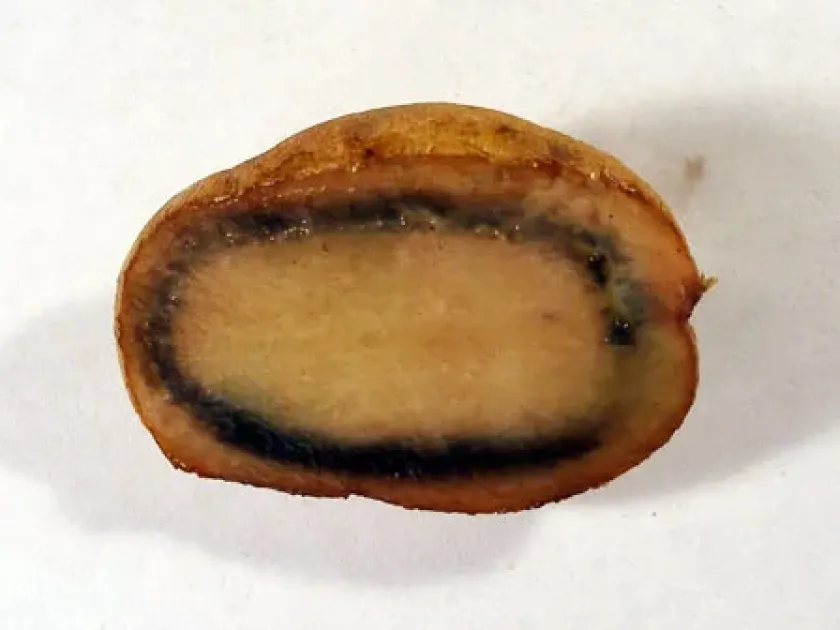
In potatoes, it is responsible for brown rot. Infection leads to the rapid wilting of stems and the internal decay of tubers, rendering the harvest useless and potentially contaminating the soil for future seasons.
For tomato and pepper plants, the disease manifests as sudden, irreversible wilting. Affected plants often collapse within a few days, even if they appeared perfectly healthy shortly before the onset of symptoms.
Beyond crop plants, the bacterium can inhabit various weed species, which act as silent reservoirs. This makes clearing fields of visible hosts insufficient to eradicate the pathogen completely from a plot.
The economic impact is profound, as infestations often lead to total crop failure and the restriction of land use for agricultural purposes for several years, causing significant financial losses to farmers.
When it appears
Ralstonia solanacearum is primarily a warm-climate pathogen. It develops optimally in temperatures ranging from 27°C to 32°C, making its impact most severe during the peak of the summer season.
The disease cycle is closely linked to soil moisture levels. High humidity and heavy rainfall promote the movement of the bacteria through the soil and surface water, facilitating its spread across fields.
Infection often occurs through the root system, where the bacteria enter via natural openings or mechanical wounds caused by cultivation or soil pests. Once inside, the bacterium moves rapidly upwards into the stem.
During the cooler months or in temperate regions, the pathogen enters a period of dormancy. It can remain in the lower layers of the soil or within the roots of perennial weed hosts until temperatures rise again.
Irrigation management is critical during the growing season. Using water from contaminated streams or ponds is a frequent cause of large-scale field outbreaks, emphasizing the need for clean water sources.
Signs of infestation
The initial symptom is the wilting of the youngest leaves, usually observed during the hottest part of the day. Plants may seem to recover at night when transpiration rates are lower.
As the infection progresses, wilting becomes permanent and spreads throughout the entire plant. Despite the severe wilting, the leaves may initially retain their green color, which is a characteristic symptom.
A diagnostic sign can be seen by cutting a cross-section of the stem. The vascular tissues will exhibit a noticeable browning or darkening compared to healthy tissues.
When a cut stem is suspended in a container of water, a cloudy, milky-white stream of bacterial cells will often ooze from the vascular bundles. This is a common and quick field-level identification technique.
Potato tubers affected by the disease show dark vascular rings in cross-sections. In advanced stages, the internal tissues turn into a soft, slimy rot that often emits an unpleasant, foul odor.
Control measures
The most important control measure is the use of disease-free, certified seed tubers and transplants. Inspecting all plant material before planting is the first line of defense against the introduction of the pathogen.
Integrated pest management includes strict crop rotation. Avoiding susceptible Solanaceous crops for at least 3–5 years on infested land is necessary, combined with the rigorous removal of all weeds.
Sanitation is paramount. All tools, machinery, and footwear must be disinfected after working in infested areas to prevent the mechanical transfer of bacterial cells to clean fields.
If an infection is detected, all symptomatic plants must be removed immediately, including the surrounding soil, and disposed of by burning or deep burial to prevent the spread of the bacteria.
Although chemical control options are limited, soil solarization can be an effective method in some climates to reduce the bacterial population in the upper soil layers before planting.
Causes diseases · 2
Discussion
No discussions yet — be the first.