Polish variety, bred in 1960 by S. Zalivsky from open pollination of the Schattenmorelle (English Morel, Lotovaya) variety. Included in the State Variety Testing in 1985.
Trees range from low to medium height, with round-pyramidal, moderately dense crowns. Fruit-bearing habit is mixed — on one-year-old branches and flower clusters.
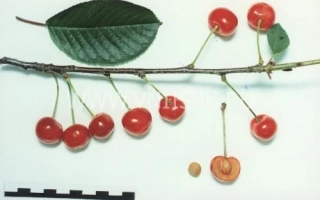
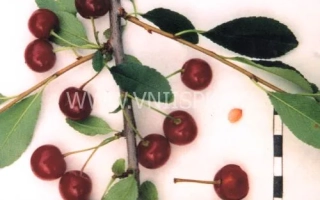
Fruits are large, 18 x 19 x 17 mm, weighing up to 5 g, dark red, round, slightly compressed vertically, with a characteristic flat ventral seam, rounded apex with a sunken stigma scar, fine and narrow hilum, and a broad groove along the dorsal seam. Flesh is dark red, moderately firm, juicy, tart-sweet in taste, with ruby-red juice. Pit is 11 x 9 x 7 mm, oval or slightly egg-shaped, smooth, weighing 0.4 g, making up 8% of the fruit's total weight, easily separates from the flesh. Pedicel averages 31 mm, attached moderately to the fruit, detaches with dry separation.
Begins fruiting in the 4th year after grafting. Flowering period is medium-early; ripening is medium-late — second half of July (10-12 days earlier than Lotovaya plum). Exhibits good self-fertility; best pollinators are Griot Ostgheim and Lotovaya. Productive. Suitable for mechanized harvesting. Variety is sensitive to winter cold. Weakly resistant to fungal diseases. Fruits are recommended primarily for processing.
In several European countries — Poland, Bulgaria, Romania — the Nepris plum has gained significant cultivation. In Russia, it can be grown in regions and areas characterized by mild winter climatic conditions.
Advantages: restrained plant growth, large fruits.
Disadvantages: sensitivity to low winter temperatures, susceptibility to fungal diseases.