

SKU #73390
·
63 views
RAMONSKAYA SLASTENA
Stevia
Фгбну Внии Сахарной Свеклы И Сахара Имени А.Л.МазлумоваUser rating
0 votes0% positive reviews
No ratings yet — be the first.
Medicinal Plants
Stevia
Stevioside content, %
12-14
Assignment
Sweetener, Medicinal
Green Mass Yield (t/ha)
0.5-1.0
About product

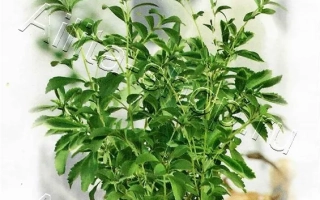
Stevia RAMONSKAYA SLASTENA is a variety of Stevia rebaudiana (Bertoni) Bertoni plant, bred at the VNIIS named after A.L. Mazlumov by individual selection from Brazilian forms. It is widely used as a natural sweetener in confectionery and canning industries and for therapeutic nutrition due to its high glycoside content (about 14%).The plant is characterized by a loose bush height from 42 to 59 cm…
Medicinal Plants
Stevia
Stevioside content, %
12-14
Assignment
Sweetener, Medicinal
Green Mass Yield (t/ha)
0.5-1.0
Description
Stevia RAMONSKAYA SLASTENA is a variety of Stevia rebaudiana (Bertoni) Bertoni plant, bred at the VNIIS named after A.L. Mazlumov by individual selection from Brazilian forms. It is widely used as a natural sweetener in confectionery and canning industries and for therapeutic nutrition due to its high glycoside content (about 14%).
The plant is characterized by a loose bush height from 42 to 59 cm with several stems. Leaves are opposite, lanceolate in shape, about 7-9 sq. cm in area, green in color and slightly pubescent on the underside; root leaves are darker and smoother. Flowers are small, tubular and white, collected in a thyrsiform panicle. The root system consists of a short thick rhizome and a dense tufted system of adventitious roots with a diameter of up to 10 cm, which ensures drought resistance.
Yield of green mass reaches 54.8 c/ha, and dry leaves – 6.25 c/ha. The vegetative period is approximately 90–95 days from planting seedlings to the beginning of flowering. The variety is resistant to root rots and moderate drought, but it does not possess frost hardiness and requires protection during the cold season. For cultivation, sunny sandy soils with pH 5.5–6 are recommended; the plant poorly tolerates clayey soil.
Stevia RAMONSKAYA SLASTENA is valued not only as a sweetener: its leaves have antimicrobial and antifungal properties, contribute to increasing immunity and lowering cholesterol levels. During collection, usually hard lower leaves are removed, leaving the soft green mass, which can be dried in a single layer on cotton fabric or used for brewing. In combination with mint, lemon balm, calendula and other herbs, it creates an aromatic mix suitable both for cooking and for medicinal infusions.
The plant is characterized by a loose bush height from 42 to 59 cm with several stems. Leaves are opposite, lanceolate in shape, about 7-9 sq. cm in area, green in color and slightly pubescent on the underside; root leaves are darker and smoother. Flowers are small, tubular and white, collected in a thyrsiform panicle. The root system consists of a short thick rhizome and a dense tufted system of adventitious roots with a diameter of up to 10 cm, which ensures drought resistance.
Yield of green mass reaches 54.8 c/ha, and dry leaves – 6.25 c/ha. The vegetative period is approximately 90–95 days from planting seedlings to the beginning of flowering. The variety is resistant to root rots and moderate drought, but it does not possess frost hardiness and requires protection during the cold season. For cultivation, sunny sandy soils with pH 5.5–6 are recommended; the plant poorly tolerates clayey soil.
Stevia RAMONSKAYA SLASTENA is valued not only as a sweetener: its leaves have antimicrobial and antifungal properties, contribute to increasing immunity and lowering cholesterol levels. During collection, usually hard lower leaves are removed, leaving the soft green mass, which can be dried in a single layer on cotton fabric or used for brewing. In combination with mint, lemon balm, calendula and other herbs, it creates an aromatic mix suitable both for cooking and for medicinal infusions.
Crop & resistance
Disease resistance
Specifications
| Medicinal Plants | |
|---|---|
| Stevioside content, % | 12-14 |
| Assignment | |
| Green Mass Yield (t/ha) | 0.5-1.0 |
| Registration year | 1995 |
| Catalog | Catalog → Stevia |
| Manufacturer | Фгбну Внии Сахарной Свеклы И Сахара Имени А.Л.Мазлумова |
| Country | Russia |
Store offers
Prices are updated on loadLoading offers…
Aggregator catalog: prices are collected automatically from store websites, normalized by AI and converted at the current exchange rate. Before ordering, confirm the price and availability on the store's website. This block is not indexed by search engines — the data is loaded after the page opens.
Not yet комментариев. Be the first!


STAVROPOL STEVIA
Фгбоу Во Ставропольский Государственный Аграрный Университет
058 1 offer
0.31 € ≈ 16 ₴


See also
Often considered together with this variety





Recently viewed
Products you’ve viewed on this site
Reviews · 0