This variety was developed at the Dubovsky Experimental Station of the Nizhnevolsk NIIISKh from a cross between Early Blue and Summer Ternosliv. Authors: V.A. Korneev, R.A. Korneev. Included in the State Register in 1959.
Trees are medium-sized with a broad-pyramidal crown of medium density. Bark on the trunk and main scaffold branches is dark brown and slightly flaking. Shoots are brown and straight. Buds are few, yellowish. Buds are small, conical, brown. Leaves are elliptical, short-pointed, slightly wrinkled, matte. Leaf blade is concave, weakly hairy, base rounded. Leaf margins are toothed and wavy. Petioles are medium in size and thickness, pigmented; trifoliate leaves are medium-sized, strongly lobed, late-falling, with few glands, round, yellow, medium-sized. Flowers are double, solitary, white, medium-sized. Fruit set is mainly concentrated on cluster branches, spurs, and long shoots from the previous year.
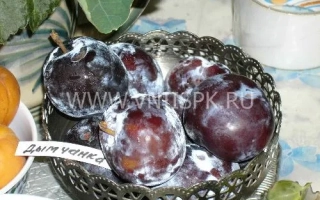
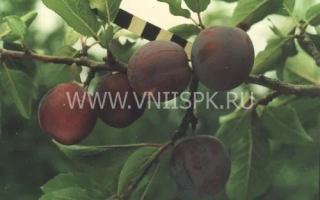
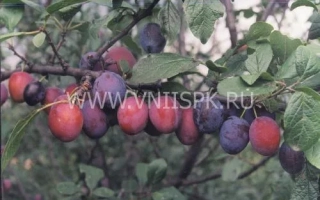
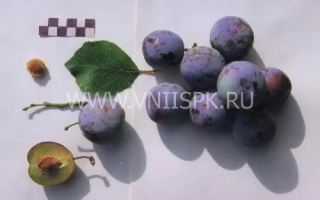
Fruits are large (average weight 35-40 g), round-oval, with a wide groove, depressed apex, and a depression at the base. Skin color is dark raspberry with numerous dark-purple spots. Skin is covered with a strong waxy coating. Flesh is orange, fibrous, juicy, sour-sweet. Juice is colorless. Stone is medium, elongated, with a short neck, easily detaching. Pedicel is medium, firmly attached to the stone. Stone-to-fruit weight ratio is 7-8%. Fruits contain 17% dry matter, 9.4% sugars, 1.7% acids, and 9.33 mg/100g ascorbic acid. Transportability is good. Fruits are suitable for fresh consumption and various processing methods.
Flowering occurs in the first decade of May; fruit ripening occurs in the second half of August. Fruit-bearing begins on the 3rd-4th year after planting in orchards with one-year-old seedlings. The variety performs well on large-fruited thorn, homegrown plum, downy cherry, and apricot. It is self-fertile but yields best when pollinated by July, Early, Red, Ispolin, and Bogatyr varieties. Yield is high and stable, increasing rapidly: 4-year-old trees yield up to 10-12 kg, 5-year-old trees up to 50 kg, mature trees up to 150 kg of fruit per tree. Cold hardiness is very high, both in wood and fruit buds. Susceptibility to diseases and pests is low. Drought resistance is high. Suitable for cultivation in intensive orchards.
Advantages: high winter hardiness, stable, high yield, fruit quality, small trees.
Disadvantages: under suboptimal agroclimatic conditions, fruits become smaller and fruit quality decreases.