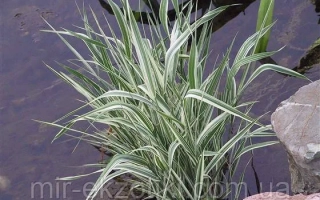
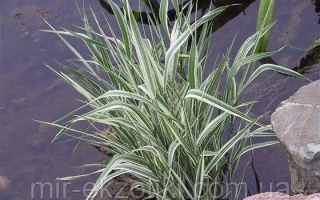
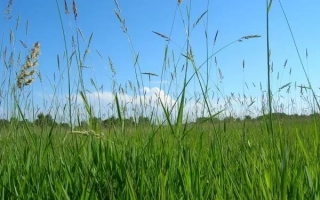
Elymus "Buriatian" – a perennial grass of the Elymus genus belonging to the Poaceae family, of the spring-winter type. The plant is characterized by a dense, multi-stemmed bush 60–120 cm high with smooth stems and well-leafed leaves 15–30 cm long and 0.8–1.4 cm wide. The leaves are linear, flat, rough, and sometimes slightly hairy, which provides high resistance to cold and drought.
The root system is tufted and deeply penetrating (120–150 cm), allowing the plant to effectively use moisture and strengthen the soil cover. The inflorescence is a loose spike 10–25 cm long, hanging down, containing 13–30 spikelets with 5–7 flowers each. The fruit is an elongated membranous caryopsis of grayish-yellow color, 6–22 mm long; one spike contains 50 to 100 seeds, and the mass of 1000 seeds is 2–5.5 g.
Elymus "Buriatian" grows on loamy, loamy sandy, and sandy soils, as well as on floodplain meadows, dry lands, and mountain slopes. It prefers pH 6.5–7.5 but tolerates a decrease to 5.6. The vegetative period is 94–109 days. The plant is used for hay and silage production, and to a lesser extent for pasture; hay yield reaches up to 3 cuttings, and when grown together with alfalfa and clover, 30–40 c/ha.
The "Buriatian" variety includes Kamalinsk 7, Guran, Nurbinsk, Gornoaltaisk 86, Mashuk, and Amginsk. The plant is cross-pollinated and self-pollinated, ecologically plastic, but not resistant to diseases. Thanks to its cold and drought resistance, Elymus is widely used in agronomy for greening, improving the soil cover, and as a component in crop systems, especially in the permafrost zone (Yakutia, Magadan).