

SKU #73545
·
64 views
Reed canary grass Antares
Reed Canary Grass
User rating
0 votes0% positive reviews
No ratings yet — be the first.
Assignment
Hay, Grazing Use
Vegetation Period
90-120
Registration year
2019
About product

ANTARES is common reed-rush (Phalaris arundinacea L.), known for its dense and slightly spreading bushiness. The plant reaches a height of up to 185 cm, but is usually found in the range of 56–109 cm in mows. Stems are round, hairless, with brown nodes, while leaves are light green and lanceolate in shape, ranging from 20 to 120 cm in length. Seeds are brown, 3–4 mm in length and 0.8–1.0 mm in wid…
Assignment
Hay, Grazing Use
Vegetation Period
90-120
Registration year
2019
Description
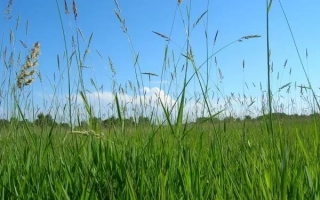
ANTARES is common reed-rush (Phalaris arundinacea L.), known for its dense and slightly spreading bushiness. The plant reaches a height of up to 185 cm, but is usually found in the range of 56–109 cm in mows. Stems are round, hairless, with brown nodes, while leaves are light green and lanceolate in shape, ranging from 20 to 120 cm in length. Seeds are brown, 3–4 mm in length and 0.8–1.0 mm in width. The rhizome is powerful, ensuring seed non-shattering and plant longevity – up to ten years.
The variety is distinguished by high green mass yield (up to 258 c/ha) and hay (up to 57.5 c/ha), as well as good seed productivity (1.3–2.02 c/ha). It is resistant to diseases but may be damaged by grain fly. The vegetation period lasts about 96–101 days, during which the plant retains a light green leaf color throughout the season. Due to its dense structure and low height in the first year of sowing, ANTARES is suitable for creating decorative carpets and soil covering.
The application of this variety is multifaceted: it is used as fodder for livestock in the early spring period, as well as in grass mixtures with common knapweed or hybrid clover – for hay. Under a two-cut regime, fertilizers are applied N60P60K60 in spring and N60P30K30 after cutting. Due to moisture and frost resistance, the plant is easily grown in groups, forming dense carpets, making it ideal for both agricultural use and landscape design.
The variety is distinguished by high green mass yield (up to 258 c/ha) and hay (up to 57.5 c/ha), as well as good seed productivity (1.3–2.02 c/ha). It is resistant to diseases but may be damaged by grain fly. The vegetation period lasts about 96–101 days, during which the plant retains a light green leaf color throughout the season. Due to its dense structure and low height in the first year of sowing, ANTARES is suitable for creating decorative carpets and soil covering.
The application of this variety is multifaceted: it is used as fodder for livestock in the early spring period, as well as in grass mixtures with common knapweed or hybrid clover – for hay. Under a two-cut regime, fertilizers are applied N60P60K60 in spring and N60P30K30 after cutting. Due to moisture and frost resistance, the plant is easily grown in groups, forming dense carpets, making it ideal for both agricultural use and landscape design.
Crop & resistance
Crop
Specifications
| Assignment | |
|---|---|
| Vegetation Period | 90-120 |
| Registration year | 2019 |
| Catalog | Catalog → Reed Canary Grass |
| Legal data | |
| Country | Russia |
Store offers
Prices are updated on loadLoading offers…
Aggregator catalog: prices are collected automatically from store websites, normalized by AI and converted at the current exchange rate. Before ordering, confirm the price and availability on the store's website. This block is not indexed by search engines — the data is loaded after the page opens.
Not yet комментариев. Be the first!
Alternatives
Reed Canary Grass · similar varieties
See also
Often considered together with this variety





Recently viewed
Products you’ve viewed on this site
Reviews · 0