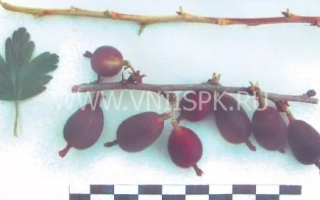
Mid-late maturing variety, developed at the VNIIS (Institute of Horticulture named after I.V. Michurin) by crossing varieties 'Kaptivator 0-271' and 'Besshipny-3'. Authors: K.D. Sergeeva, E.Yu. Koveshnikova. Under state variety testing since 2002.
Medium-height, slightly spreading, moderately dense and branched bush. Growing shoots are medium, straight, light-green, without anthocyanin pigmentation, hairless, matte. Woody shoots are thick and light-colored. Thorns on shoots are moderate. Thorns are single and double, short, medium thickness, straight, matte, dark-colored, pointing downward relative to the shoot and located only in the lower part. Buds are egg-shaped, small to medium, blunt-tipped, dark, hairless, deviated. Leaf scar is round.
Leaf is small to medium-sized, light-green, slightly shiny, hairless, slightly wrinkled, leathery, concave. Margins are medium, blunt, slightly curled. Main vein coloration absent. Leaf is three- to five-lobed, lobes with medium indentations, central lobe is round, blunt-tipped, slightly exceeds lateral lobes, its lateral edges are straight or slightly rounded. Lateral lobes are medium-length, broad, round, angle between lobe veins is acute. Leaf base is straight or with small notch, angle between leaf blade base and petiole is right angle. Petiole is short, thick, with sparse glandular hairs at lower part, positioned at 45° angle to the shoot.
Flowers are small, pale. Sepals are medium, pale, free, arranged horizontally. Inflorescence is predominantly two-flowered. Ovule is naked.
Berries are medium to large (3.4–4.8 g), round or round-oval, dark-red, hairless, covered with waxy coating. Moderate seed count. Skin is medium, with weak venation, veins slightly branched, pink-red, lighter than main fruit color. Taste is sour-sweet (4.2 points). Receptacle is medium, full, closed. Berry stem is short, conical, fleshy, with intense anthocyanin pigmentation at base. Chemical composition: soluble dry matter — 13.1%, total sugars — 10.7%, titratable acidity — 2.4%, ascorbic acid — 28.0 mg/100 g. Berries are of universal use.
Winter-hardy variety, average yield 12.0 t/ha (3.6 kg/plant), resistant to American powdery mildew.
Advantages of the variety: high winter hardiness, resistance to American powdery mildew, low thorniness of shoots, good biochemical and technological berry qualities.
Disadvantages of the variety: medium berry size and taste quality.