


SKU #4725
·
217 views
Change
Gooseberry
User rating
0 votes0% positive reviews
No ratings yet — be the first.
Usage
Universal
Berry Color
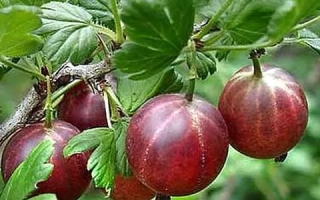
Dark red
Berry flavor
Sour-sweet
Thorniness of shoots
Average
Prices in stores
from4.35 €per seedling
pack from 3.23 € per pack
2 offers from 1 store
Store offers · 2 from 1 stores
Prices are updated on loadLoading offers…
Available at: Garshinka
Aggregator catalog: prices are collected automatically from store websites, normalized by AI and converted at the current exchange rate. Before ordering, confirm the price and availability on the store's website. This block is not indexed by search engines — the data is loaded after the page opens.
About product

Medium-ripening variety. Developed at the Moscow Fruit and Berry Experimental Station (now VSSITSP) in 1933 from the cross of Hautton x Green Bottle. Author M.N. Simonova. Since 1959, it has been included in the State Register of Breeding Achievements approved for use in the Northern, Northwestern, Central, Volga-Vyatka, Central Chernozem, Middle Volga, Lower Volga, Ural, West Siberian, and Far E…
Usage
Universal
Berry Color
Dark red
Berry flavor
Sour-sweet
Thorniness of shoots
Average
Description
Medium-ripening variety. Developed at the Moscow Fruit and Berry Experimental Station (now VSSITSP) in 1933 from the cross of Hautton x Green Bottle. Author M.N. Simonova. Since 1959, it has been included in the State Register of Breeding Achievements approved for use in the Northern, Northwestern, Central, Volga-Vyatka, Central Chernozem, Middle Volga, Lower Volga, Ural, West Siberian, and Far Eastern regions.
Strong-growing, moderately spreading bush under fruit load. Bush has strong branching with inclined branches. Non-woody stems are medium thickness, curved, hairless, light-green, with weak anthocyanic coloring on the tips. Woody stems are medium thickness, curved, long, gray-colored with characteristic stripes along the entire stem length. Thorniness is moderate, thorns are single, short, less than 7 mm, medium thickness, dark, matte. Thorns are located along the entire stem length. Small thorns are present along the entire stem length, except at the tip. Buds are elongated, medium size, with pointed, light-colored tips, light-brown color, without hairs. Terminal bud is single. Bud arrangement on stems is opposite. Position relative to stem is appressed.
Leaves are three-lobed, large and medium-sized, light-green with weak gloss. Hairs are present on upper and lower leaf surfaces. Surface is smooth. On upper stem parts, leaves are slightly concave. Leaf margin teeth are small, tooth tips are straight and rounded. Main vein color is green. Middle lobe is slightly shorter than lateral lobes, length equals width. Teeth are rounded, straight, wide alternate with narrow ones. Angle between middle and lateral lobes is acute. Cutout is deep, leaf lobe edges overlap each other. Lateral lobes have width shorter than length. Vein direction is toward the tip. Basal lobes are developed. Leaf base is straight. Petiole notch is small. Petiole is long, thin, glandular-hairy, green-colored, positioned on stem at 45° angle.
Flowers are medium-sized, sepals are light-green with pink edges, arranged loosely. Stigma hairs are absent. Inflorescence is two- or three-flowered.
Berries are small to medium-sized (2.5–3.5 g), round, dark-red, with waxy coating, tart-sweet. Skin thickness is moderate. Veining is weak, diffuse, vein color is lighter than fruit flesh. Seeds are small. Receptacle is medium, closed, does not fall off, pedicel is short. Chemical composition: dry matter — 13.4%, sugar sum — 9.4%, titratable acidity — 2.1%, ascorbic acid — 28.0 mg/100 g, anthocyanins — 10.0 mg/100 g.
Advantages of the variety: resistance to powdery mildew, high shoot recovery ability, early fruiting, productivity.
Disadvantages of the variety: rapid bush crowding, susceptibility to pests, insufficient berry mass.
Video · 1 video
Suggest a video →Crop & resistance
Crop
Disease resistance
Specifications
| Usage | |
|---|---|
| Berry Color | |
| Berry flavor | |
| Thorniness of shoots | |
| Berry Weight | 2,5-3,5 |
| Resistance to Powdery Mildew | |
| Pest Resistance | |
| Catalog | Catalog → Gooseberry |
Not yet комментариев. Be the first!
Alternatives
Gooseberry saplings · similar varieties




See also
Often considered together with this variety


Hinnonmainen punainen (OLAVI, hinnonmainen punainen, olavi)
0293 5 offers
9.82 €per seedling ≈ 507 ₴


Recently viewed
Products you’ve viewed on this site
Reviews · 0