


SKU #4739
·
301 views
Gooseberry Eridan
Gooseberry
User rating
0 votes0% positive reviews
No ratings yet — be the first.
Usage
Universal
Berry Color
Dark red
Yield per bush, kg
5,7-7,1
Berry flavor
Sour-sweet
Store offers · 2 from 1 stores
Prices are updated on loadLoading offers…
Available at: Сады Семирамиды
Aggregator catalog: prices are collected automatically from store websites, normalized by AI and converted at the current exchange rate. Before ordering, confirm the price and availability on the store's website. This block is not indexed by search engines — the data is loaded after the page opens.
About product

Mid-season ripening variety, obtained at the Leningrad Fruit and Vegetable Experimental Station from open pollination of the Avenarius variety. Breeder I. S. Studenskaia. Included in the State Register of Selection Achievements approved for use in the Volga-Vyatka region in 2009.
Medium-height, spreading, moderately dense bush. Stems of medium thickness, straight and arching. Growing stems are…
Usage
Universal
Berry Color
Dark red
Yield per bush, kg
5,7-7,1
Berry flavor
Sour-sweet
Description
Mid-season ripening variety, obtained at the Leningrad Fruit and Vegetable Experimental Station from open pollination of the Avenarius variety. Breeder I. S. Studenskaia. Included in the State Register of Selection Achievements approved for use in the Volga-Vyatka region in 2009.
Medium-height, spreading, moderately dense bush. Stems of medium thickness, straight and arching. Growing stems are light green, without hairs. Thorns are short and medium, thin, single and double, light-colored, oriented perpendicular to the stem, distributed along its entire length. Prickles in internodes are absent.
Leaf five-lobed, medium size, green. Leaf blade shiny, without hairs, smooth, straight, soft in texture. Teeth are blunt, short, not curled. Leaf base is straight. Leaf petiole is medium length, thin, green. Leaf is positioned upward and sideways relative to the stem.
Flowers medium-sized, pale-colored. Ovular ovary, without hairs. Inflorescence is single- or two-flowered.
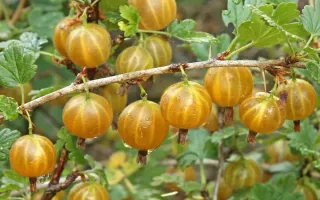
Berries are medium to small (average mass 3.0 g, maximum 3.9 g), round-oval in shape, dark red, without hairs, covered with a waxy coating. Skin is of medium thickness, firm. Flesh is juicy, with good tart-sweet flavor and aroma, rated 4.0 points. Receptacle is long, narrow, half-closed. Peduncle is medium length, thin, green. Chemical composition: total sugar content — 9.2–11.0%, titratable acidity — 2.2–2.8%, ascorbic acid — 24.2–27.0 mg/100 g. Berries are of universal use.
Frost-resistant, drought-tolerant variety, yield 5.7–7.1 kg/plant, resistant to powdery mildew, anthracnose, and septoria, with slight infection.
Advantages of the variety: high frost resistance and resistance to powdery mildew, stable fruiting.
Disadvantages of the variety: low berry mass.
Crop & resistance
Crop
Disease resistance
Specifications
| Usage | |
|---|---|
| Berry Color | |
| Yield per bush, kg | 5,7-7,1 |
| Berry flavor | |
| Thorniness of shoots | |
| Berry Weight | 3,0-3,9 |
| Resistance to Powdery Mildew | |
| Frost Resistance | |
| Catalog | Catalog → Gooseberry |
Not yet комментариев. Be the first!
Alternatives
Gooseberry saplings · similar varieties


See also
Often considered together with this variety




Recently viewed
Products you’ve viewed on this site
Reviews · 0