A popular summer variety developed by local selection, widely cultivated in Astrakhan and southern Volgograd regions. It has been officially approved in the Nizhnevолжский region.
A vigorous, fast-growing tree, reaching 12-15 meters in height by age 40-50. The crown is tall, pyramidal, dense, and heavily foliated. Main branches emerge from the trunk at a 45-degree angle, slightly curved, thick, brown, with cracked bark.
Shoots are olive-yellow, long, medium thickness, curved, slightly knotted, with a moderate number of large, round, bean-like buds. Buds are large, medium width, broad-conical, strongly deviated. Leaves are large, broad, round or broadly egg-shaped, dark green, smooth, thick, leathery, slightly concave, with slightly wavy, finely toothed edges. Petioles are relatively short, without anthocyanin. Stipules are medium, filamentous.
Flowers are large, white, 4-7 per cluster. Sepals are light green, narrow-triangular, with a sharp apex. Petals are large, round, with a medium claw. Stamens in each flower are 22-25, with white filaments and rose-colored anthers. The pistil is located below the stamens.
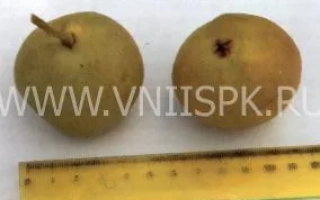
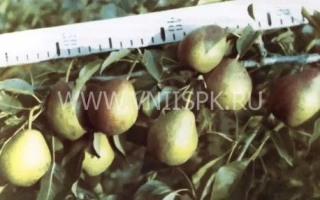
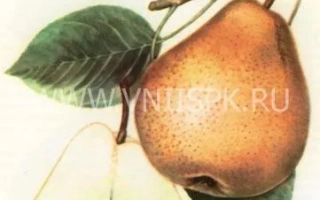
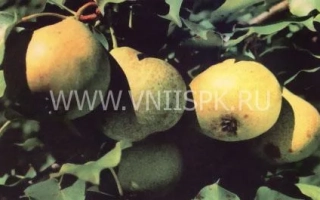
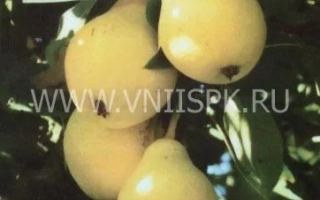
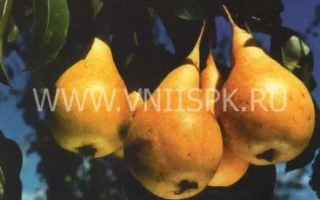
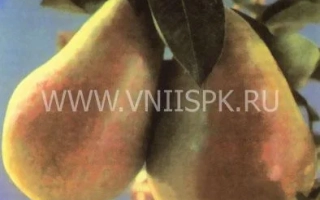
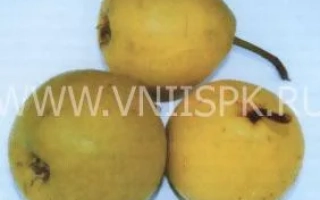
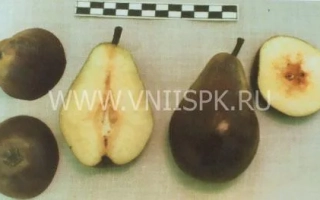
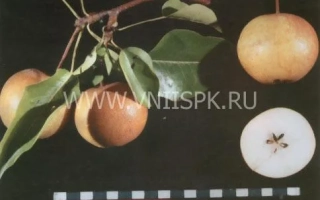
Fruits are large and medium-sized, uneven, weighing up to 400 g (Astrakhan) and 200-300 g (Volgograd region). Fruit shape is pear-shaped or broad-pear-shaped.
Fruits are strongly ribbed, bumpy, slightly oily to the touch. Main color is yellow-green, with occasional rare russet shading on sunny sides (up to 1/3 of the fruit surface). The calyx is half-open, medium-sized, sepals separate, elongated-pointed. Pedicel is long, thick, curved, woody, oblique, with a swelling, brown color. The receptacle is small, narrow, with a swelling and without rust. The receptacle base is small or medium, medium width, wrinkled with pearls. The calyx tube is inversely conical, medium width and depth, directly connected to the central cavity. The core is elliptical, small, located closer to the fruit apex, axial, symmetrical. Seed chambers are closed, semi-elliptical. Seeds are elongated-oval, one-sided, dark brown. No more than 4-5 seeds per fruit are fully developed; the rest are underdeveloped.
Flesh is creamy or light-yellow, dense, coarse-grained, with a moderate number of large, stone-like cells around the core, medium juiciness, slightly acidic-sweet, mildly astringent, with a medium aroma. Chemical composition: dry matter — 18.9% (14.6–22.7%), total sugars — 10.5% (8.1–13.2%), titratable acids — 0.23% (0.13–0.47%), ascorbic acid — 7.5 mg/100g (2.5–13.2%), sugar-to-acid ratio — 50.1 (23.6–98.2), polyphenolic compounds (catechins) — 30 mg/100g, flavonols — 12 mg/100g, total phenolic compounds — 307 mg/100g, total pectic substances — 0.28% (max 0.58%) on fresh weight.
Typical harvest period — third decade of August.
Fruits remain firmly attached to the tree until harvest. They are stored for 10–15 days. Fruit quality is high, up to 90%. Intended use: table consumption and processing (compote).
Best pollinators: Panna, Ilyinka. Trees begin fruiting at 9–11 years. After 2 years, they produce marketable yields. Annual, high fruiting (100–150 kg per tree). Long-lived variety. In the Volga-Akhtuba floodplain, productive trees over 80–90 years old are found.
Winter hardiness, according to field assessment, is high. Susceptible to scab, resistant to aphids and mites.
Advantages of the variety: longevity, high yield and fruit quality, resistance to pests, good winter hardiness.
Disadvantages of the variety: vigorous growth, late fruiting, moderate fruit quality.