Dried mycelium of the mushroom "Half-free Morel"
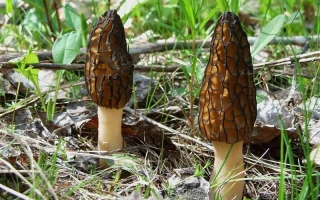
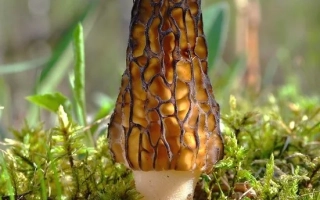
Half-free Morel is an edible mushroom, used after preliminary boiling (about 20 minutes). It grows in light deciduous forests, on clearings, and prefers aspens and limes. It can also grow among birches, oaks, even in dense alder thickets. Cap: conical, small, half-free Morel differs from common Morel in that its cap does not fuse with the stem, and its lower part freely rests above the stem, like a hat. The cap is brown, with sharp longitudinal ridges and large irregular rhomboid cells. Stem: whitish or yellow, hollow. The height of the mushroom, including the cap, reaches 4-15 cm, but larger specimens are also encountered. Flesh: very brittle, thin with a specific odor.
Cultivation of Half-free Morel on a garden plot: select a slightly shaded, moist area, avoiding direct sunlight. It is preferable to choose a location under apple trees. If the plot is not shaded, install a canopy to protect from sun and wind. Remove weeds and grass from an area of 1 m2, remove the topsoil layer to a depth of 15 cm.
Mix 65% topsoil (brown peat), 30% wood ash (paper, cardboard, straw ash), 5% gypsum or plaster with apple waste. Dig trenches around the perimeter for drainage of meltwater. The bed is prepared in spring. Before sowing mycelium, moisten the bed. On the surface of the bed, spread the mycelium mixed with substrate to a depth of 10-12 cm, water it, cover with a layer of removed soil about 6 cm, and cover with dry leaves or straw (1-8 cm). Water using drip irrigation in dry weather (do not use chlorinated water). In early spring of the following year, remove the cover.
It is recommended to apply a small amount of ash (in water solution during watering, at a rate of 1 liter of ash per 1 m2) and apple pomace (pressings) annually. Dosage: 10 grams of mycelium (1 packet) per 1 m2. To obtain a stable yield in the same season each year, additional (repeated) application of mycelium is required annually.