

SKU #73552
·
74 views
DACHTNAYA
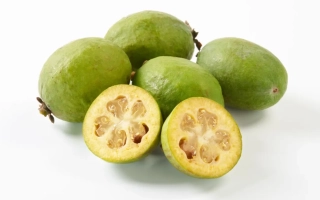
Feijoa
User rating
0 votes0% positive reviews
No ratings yet — be the first.
Exotic Cultures
Feijoa
Rind Color
Green
Flavor
Sour-sweet
Registration year
2017
About product

A productive and robust variety, perfect for commercial scaling and high-quality fruit processing.
Exotic Cultures
Feijoa
Rind Color
Green
Flavor
Sour-sweet
Registration year
2017
Description
A Proven Selection for Subtropical Agriculture
The «Dachnaya» feijoa variety, developed by the Federal Research Center for Subtropical Sciences (Russia/Georgia origin), serves as a reliable solution for those focused on consistent yields and commercial grade quality. This variety is specifically selected by growers who prioritize hardiness and predictable harvest cycles in subtropical climates.
Practical Applications and Operational Use
- Orchard Management: Due to its resilience, the variety is well-suited for both high-density plantations and smaller-scale estate production. Its growth habit allows for effective canopy management, facilitating easier manual harvesting.
- Market Readiness: The dark green skin provides a distinct aesthetic appeal, while the fruit's robust texture ensures better transport stability compared to more fragile exotics. This reduces post-harvest losses significantly.
- Processing Potential: With its balanced sweet-and-sour profile, «Dachnaya» is highly sought after by processing facilities. It is an ideal base for jams, purees, and fruit-based beverages, requiring minimal additives due to its natural flavor intensity.
Adopting the «Dachnaya» variety allows for streamlined agricultural operations. By focusing on standard irrigation and seasonal pruning protocols, growers can achieve long-term productivity and satisfy market demand for high-quality, exotic fruit.
Specifications
| Exotic Cultures | |
|---|---|
| Rind Color | |
| Flavor | |
| Registration year | 2017 |
| Catalog | Catalog → Feijoa |
| Legal data |
Show · 2
|
| Country | Georgia |
Store offers
Prices are updated on loadLoading offers…
Aggregator catalog: prices are collected automatically from store websites, normalized by AI and converted at the current exchange rate. Before ordering, confirm the price and availability on the store's website. This block is not indexed by search engines — the data is loaded after the page opens.
Not yet комментариев. Be the first!


See also
Often considered together with this variety




Recently viewed
Products you’ve viewed on this site
Reviews · 0