


SKU #4412
·
250 views
Zagadka
Currant
User rating
0 votes0% positive reviews
No ratings yet — be the first.
Type of Sort
Blackcurrant
Store offers · 2 from 2 stores
Prices are updated on loadLoading offers…
Available at: Агростор · Megasad · Наша Дача · Sadim · Ycadba
Aggregator catalog: prices are collected automatically from store websites, normalized by AI and converted at the current exchange rate. Before ordering, confirm the price and availability on the store's website. This block is not indexed by search engines — the data is loaded after the page opens.
About product

Mid-early maturing variety, obtained at VSTISP from crossing the varieties Nina and Competitor. Author V.M. Litvinova. Included in the State Register of Varieties approved for use in the Central, Volgo-Vyatka, and North Caucasus regions in 1986.
Medium-height, compact, dense bush. Growing shoots are thick, light green with a reddish tip, sparsely hairy, woody — thick, straight, brown. Buds are…
Type of Sort
Blackcurrant
Description
Mid-early maturing variety, obtained at VSTISP from crossing the varieties Nina and Competitor. Author V.M. Litvinova. Included in the State Register of Varieties approved for use in the Central, Volgo-Vyatka, and North Caucasus regions in 1986.
Medium-height, compact, dense bush. Growing shoots are thick, light green with a reddish tip, sparsely hairy, woody — thick, straight, brown. Buds are egg-shaped, medium-sized, blunt, pinkish, with bright scales, hairless, solitary, sit on short stems, pressed against the shoot at the upper part, and from the middle — bent away, terminal — non-free, leaf scar shape wedge-shaped.
Leaf five-lobed, medium-sized, green, hairless, matte, wrinkled, leathery. Central lobe is wide, longer than lateral ones, with protrusions, tip acute. Lateral lobes are short, broad, angle between their veins is straight. Basal lobes are poorly developed. Notch at base is rounded, small. Teeth are blunt, short, without distinct tip, petiole medium length and thickness, hairless, green with pinkish "tan".
Flowers medium-sized, cup-shaped, sepals pale-pink, free, curled, sometimes twisted. Inflorescence medium (6-8 cm), medium density, axis medium thickness, hairless, petiole medium, pedicel medium length, green, hairless.
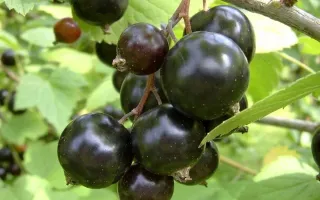
Berries large (average weight 1.2 g, maximum — 2.2 g), round, black, dry detachment, with average number of seeds. Receptacle medium, falls off, closed. Taste sour-sweet (4 points), with aroma. Berries are of universal use. Chemical composition: total sugars — 5.4%, titratable acidity — 0.2%, ascorbic acid — 160.0 mg/100 g.
Cold-resistant, self-fertile, characterized by high field resistance to diseases and pests, average yield 11.4 t/ha (3.0 kg/plant).
Advantages of the variety: large-fruited, productive, upright growth, resistant to powdery mildew and anthracnose.
Disadvantages of the variety: requires care (soil cultivation, fertilizer application), needs periodic removal of peripheral branches.
Video · 2 videos
Suggest a video →Crop & resistance
Crop
Disease resistance
Specifications
| Type of Sort | |
|---|---|
| Catalog | Catalog → Currant |
Not yet комментариев. Be the first!
Alternatives
Currant saplings · similar varieties


See also
Often considered together with this variety



Recently viewed
Products you’ve viewed on this site
Reviews · 0