


SKU #4496
·
522 views
Currant Ojebin
Currant
Type of Variety
Blackcurrant
Your mark
0 votes
0% positive ratings
Store offers · 13 from 8 stores
13 offers in 8 stores — from 1.37 € per seedling.
Available at: Agro-market · Agrostore · botanikfoto-com · duvoflora-com-ua · Sadokshop · Сади Валерії · starkl-pl · Интернет магазин садовых растений Все Сорта
Prices are collected automatically from store websites and converted at the current exchange rate. Check the price and availability on the store website before ordering.
Description
Mid-season ripening variety, developed in Sweden, a clone of the Erkheikki variety.
Included in the State Register of Varieties Approved for Use in the Northern, Northwestern, Central, Volgo-Vyatka, Central Chernozem, Middle Volga, and Ural regions since 1988.
Low, vigorous, semi-spreading bush, prone to rapid crowding. Growing shoots are thick and medium-sized, green and pinkish, hairy, woody—thick, with slight thinning toward the tip, curved or straight, grayish-brown with brown tips, hairy. Buds are solitary, large, thick, egg-shaped with pointed tips, often asymmetric, pinkish-red or pinkish-purple, hairy, deviated from the shoot, terminal—free or with one less developed bud, cylindrical or egg-shaped with pointed tips.
Leaf three- to five-lobed, large, dark green with bronze tinge, matte, puckered, leathery, with dense woolly hairs in the midrib groove on the upper side of the leaf and very sparse hairs along the veins on both sides of the leaf. Leaf blade convex, with curled tips of lobes. Main veins are predominantly uncolored, occasionally showing faint anthocyanin spots near the base of the leaf. Central lobe is large, longer than lateral lobes, broadly triangular, with slightly elongated, pointed, downward-curled tip, with clearly defined additional protrusions, large. Lateral lobes are short, broadly egg-shaped, blunt, with tips directed toward the petiole, angle between their veins obtuse. Basal lobes are weakly expressed, their veins spread out or directed toward the petiole. Base of leaf blade is heart-shaped with deep, open, rarely with 'notch' indentation. Teeth are large but shallow, toothed with clearly visible small whitish 'nail'. Petiole is thick, medium length, colored along entire length, hairy, positioned at 45° angle to the shoot.
Flowers are large, bell-shaped or bell-shaped with expanded base, pale pink. Sepals are tongue-shaped or egg-shaped, slightly pointed, slightly colored, hairy, curled, freely arranged. Petals are egg-shaped, rounded, greenish-white, separate. Stigmas are positioned slightly above anthers. Ovule is hairy, uncolored. Inflorescences are medium length (5-7 berries), thick and medium-thick, green and bluish-green, with 'sunburn', hairy, medium density. Inflorescence pedicel is short and medium. Berry stems are medium, decreasing toward the top of the inflorescence, bluish-green, hairy.
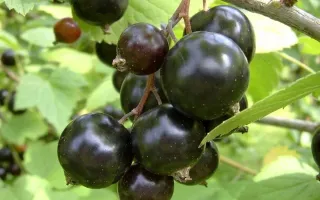
Berries are medium to large (0.9-1.5 g), round, with clearly visible seam, black, with slight gloss, uniform, skin thin with dry detachment, tart-sweet flavor (3.9 points), universal use. Calyx is medium, falling off. Chemical composition: soluble dry matter - 19.8%, total sugars - 10.6%, titratable acidity - 2.6%, ascorbic acid - 139.9 mg/100 g.
Highly winter-hardy, self-fertile (39.6%), high annual yield, 3.0-4.0 kg/plant. Resistant to powdery mildew, relatively resistant to anthracnose, susceptible to rust, double-flowering, and bud mite.
Advantages of the variety: ability to propagate by all known methods, intensive, rapid bush growth, high winter hardiness and productivity, resistance to powdery mildew, high fruit quality.
Disadvantages of the variety: severe damage from bud mite and double-flowering under inadequate care.
Video · 1 video
Suggest a video →Crop & resistance
Crop
Disease resistance
Specifications
| Type of Variety | |
|---|---|
| Catalog | Catalog → Currant |
No reviews yet. Be the first to share your experience.
Alternatives
Currant saplings · similar varieties


See also
Often considered together with this variety


Recently viewed
Products you’ve viewed on this site
Reviews