


SKU #4497
·
180 views
Cranberry
Currant
User rating
0 votes0% positive reviews
No ratings yet — be the first.
Type of Sort
Blackcurrant
About product

Medium-ripening variety, obtained at the Mountain Horticulture Department of the Siberian Institute of Horticulture named after M.A. Lisavenko from crossing the varieties 'Seyanets Golubki' and 'Slozhnokistnaya'. Author: L.N. Zabelina. Since 2000, included in the State Register of Varieties approved for use in the West Siberian region.
Bush is strong-growing, medium-dense, medium-spreading. Gr…
Type of Sort
Blackcurrant
Description
Medium-ripening variety, obtained at the Mountain Horticulture Department of the Siberian Institute of Horticulture named after M.A. Lisavenko from crossing the varieties 'Seyanets Golubki' and 'Slozhnokistnaya'. Author: L.N. Zabelina. Since 2000, included in the State Register of Varieties approved for use in the West Siberian region.
Bush is strong-growing, medium-dense, medium-spreading. Growing shoots are medium-thick, straight, greenish with a dirty-purple tip, weakly hairy, woody — grayish-brown, weakly hairy. Buds are medium-sized, egg-shaped with a pointed tip, solitary, pink, weakly hairy, pressed, terminal — clustered.
Leaf five-lobed, medium-sized and large, green, slightly wrinkled, medium density, straight, matte, without hairs. Color of main veins is rose-purple. Lobes are pointed, middle is elongated and broad, exceeding lateral ones. Angle between main veins of lateral lobes is right or obtuse. Basal lobes are well-developed, vein direction is spread or toward leaf tip. Base of leaf has a small, open notch. Teeth are large, sharp, long, with white "tips". Leaf petioles are long, weakly hairy, dirty-green, brownish-cherry on the illuminated side, anthocyanin color intensifies at both ends of the petiole, arranged at an acute angle (45°) to the shoot.
Flowers are large, sepals from bright raspberry to cream, corolla petals greenish-cream, not closed, deviated. Inflorescences are medium (6-8 berries), medium density. Pedicels are thin, weakly hairy.
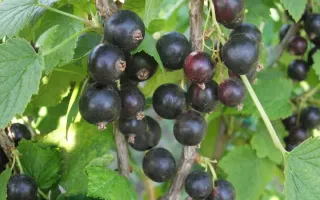
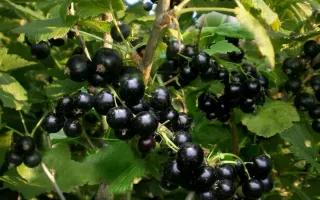
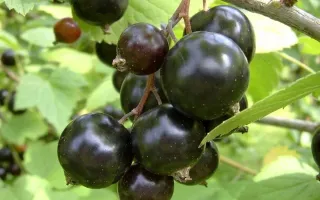
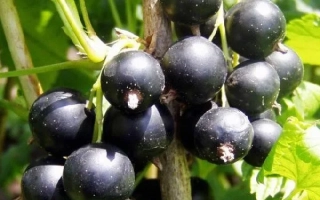
Berries are large (1.1-1.5 g), round, single-sided, black, shiny, with medium number of seeds, skin
thin, taste sour and refreshing. Seeds are medium-sized, light-brown. Calyx is medium, closed. Chemical composition: dry matter — 10.0%, total sugars — 7.6-8.4%, titratable acidity — 3.6-3.7%, ascorbic acid — 250.0 mg/100 g.
High-yielding variety (7.1-14.0 t/ha), resistant to fungal diseases.
Advantages of the variety: high yield, good recovery ability.
Disadvantages of the variety: branches may freeze in harsh winters.
Video · 3 videos
Suggest a video →Crop & resistance
Crop
Disease resistance
Specifications
| Type of Sort | |
|---|---|
| Catalog | Catalog → Currant |
Store offers
Prices are updated on loadLoading offers…
Available at: Гарденмарт
Aggregator catalog: prices are collected automatically from store websites, normalized by AI and converted at the current exchange rate. Before ordering, confirm the price and availability on the store's website. This block is not indexed by search engines — the data is loaded after the page opens.
Not yet комментариев. Be the first!
Alternatives
Currant saplings · similar varieties




See also
Often considered together with this variety





Recently viewed
Products you’ve viewed on this site
Reviews · 0