


SKU #4382
·
351 views
Currant Galinka
Currant
User rating
0 votes0% positive reviews
No ratings yet — be the first.
Type of Sort
Blackcurrant
Store offers · 5 from 4 stores
Prices are updated on loadLoading offers…
Available at: Экосад · Флора Сибири · Лучший Сад · Zberri
Aggregator catalog: prices are collected automatically from store websites, normalized by AI and converted at the current exchange rate. Before ordering, confirm the price and availability on the store's website. This block is not indexed by search engines — the data is loaded after the page opens.
About product

Medium-ripening variety, developed at the Siberian Institute of Horticulture named after M.A. Lisavenko in 1980 from crossing of varieties Seyanets Golubki and Lepaan Musta. Breeders: Z.S. Zotova, I.P. Kalinina, N.I. Nazaryuk, M.A. Pershina, I.L. Teslya, V.S. Shevkunova. Since 2001, included in the State Register of varieties approved for use in the West and East Siberian regions.
Medium-heigh…
Type of Sort
Blackcurrant
Description
Medium-ripening variety, developed at the Siberian Institute of Horticulture named after M.A. Lisavenko in 1980 from crossing of varieties Seyanets Golubki and Lepaan Musta. Breeders: Z.S. Zotova, I.P. Kalinina, N.I. Nazaryuk, M.A. Pershina, I.L. Teslya, V.S. Shevkunova. Since 2001, included in the State Register of varieties approved for use in the West and East Siberian regions.
Medium-height, medium-spreading, medium-dense bush with weak regenerative ability. Growing shoots of medium thickness, slightly curved, light-green, matte, hairless, woody — light-brown. Buds large, brown, without hairs, elongated, blunt, solitary, deviated, apical — free.
Leaf five-lobed, large and medium-sized, light-green, matte, wrinkled, leathery, blade concave. Leaf tip acute. Angle between midveins of lateral lobes obtuse, lateral lobes directed sideways. Basal lobes well-developed, veins directed toward petiole. Leaf base with narrow, deep, slightly open notch. Teeth short, sharp, with clearly defined 'claw'. Petiole medium length and thickness, green, slightly colored at edges.
Flowers medium-sized, bell-shaped, pale-pink. Sepals short. Stigma at pollen level. Inflorescences medium length, loose, hanging, axis medium thickness, green. Pedicel long, thin.
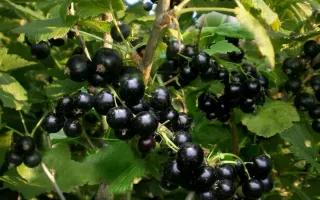
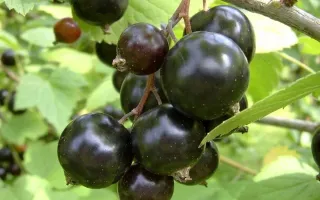
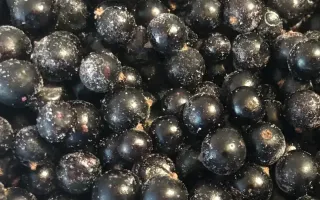
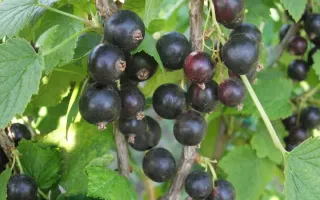
Berries very large 1.9-4.0 g, round, black, shiny, ripen simultaneously, with medium seed count, medium skin, dry detachment, good transportability. Receptacle closed. Taste sour-sweet (4.0 points), good. Berries of universal use. Chemical composition: dry solids — 12.3-4.3%, sugar sum — 7.6-9.4%, titratable acidity — 2.2-3.0%, ascorbic acid — 112.2-200.0 mg/100 g, pectic substances (on fresh weight) — 0.9-1.5%.
Cold-hardy, drought-resistant, early-bearing, self-fertile, high-yielding, average yield 10.8 t/ha (3.2 kg/plant), maximum — 13.0 t/ha. Exhibits high resistance to powdery mildew and gall mite. Slightly affected by anthracnose and bud mite, moderate susceptibility to septoria.
Advantages of the variety: self-fertility, early-bearing, high yield, high resistance to powdery mildew and gall mite, very large berries with dry detachment.
Disadvantages of the variety: low resistance to septoria.
Video · 1 video
Suggest a video →Crop & resistance
Crop
Disease resistance
Pest resistance
Specifications
| Type of Sort | |
|---|---|
| Catalog | Catalog → Currant |
Not yet комментариев. Be the first!
Alternatives
Currant saplings · similar varieties



See also
Often considered together with this variety




Recently viewed
Products you’ve viewed on this site
Reviews · 0