


SKU #4673
·
271 views
Currant Early (Early Favorovskaya)
Currant
Prices in stores
No offers yet — stores have not added prices for this product yet.
Similar varieties with prices
-
Bayana
from 1.09 €per seedling
-
 White Fairy (Diamond)
from 1.1 €per seedling
White Fairy (Diamond)
from 1.1 €per seedling
-
 Versailles Blanche
from 2.13 €per seedling
Versailles Blanche
from 2.13 €per seedling
-
 Viksne (Red Viksne, Cherry Viksne)
from 0.38 €
Viksne (Red Viksne, Cherry Viksne)
from 0.38 €
Type of Variety
Redcurrant
Your mark
0 votes
0% positive ratings
Description
Early maturing variety, developed in 1937 at the former Sui-fu-Usuriyskaya Fruit and Berry Experimental Station (Primorsky Krai) from seeds of wild blackcurrant from Palchovsky (later established as a hybrid origin). Author N.A. Bolonyaeva-Favorovskaya. It was regionally adapted throughout the Far East.
Bush is low-growing and compact. Growing shoots are medium-thick and thin, weakly hairy, light-brown. Buds are medium-sized and small, round, pressed against the shoot. Petiole trace is narrow, sickle-shaped.
Leaf is five-lobed, small, matte, slightly concave along the central vein. Base of the leaf has a small notch, lower lobes are small. Teeth are large, blunt. Petiole is long, thin, green.
Flowers are medium-sized, saucer-shaped, with a barely noticeable calyx. Sepals are green, not fused, slightly curled back. Inflorescences are medium-length (8-10 cm with petiole), dense, hanging, axis thin, green. Petiole is weakly hairy, medium-length.
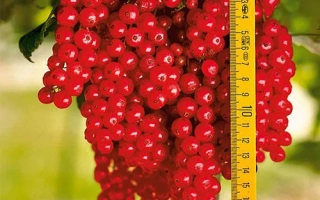
Berries are small (0.4-0.5 g), nearly one-dimensional, round, bright red, small seed count, sweet-tart flavor, score 3.0. Berries are for technical use. Calyx is round, small, closed, pedicel short. Chemical composition: dry solids — 7.8%, sugar sum — 5.6%, titratable acidity — 3.5%, ascorbic acid — 34.8 mg/100 g, P-active substances — 300.0 mg/100 g, pectin (on dry weight) — 5.1%.
Winter-hardy, high-yielding, average multi-year yield 4.5 kg/bush, self-fertile.
Advantages of the variety: winter hardiness, high yield, resistance to fungal diseases.
Disadvantages of the variety: small berry size, mediocre taste.
Crop & resistance
Crop
Specifications
| Type of Variety | |
|---|---|
| Catalog | Catalog → Currant |
No reviews yet. Be the first to share your experience.
Alternatives
Currant saplings · similar varieties


See also
Often considered together with this variety



Recently viewed
Products you’ve viewed on this site
Reviews