


SKU #4684
·
265 views
Erstling aus Firlanden
Currant
User rating
0 votes0% positive reviews
No ratings yet — be the first.
Type of Sort
Red Blackcurrant
Store offers · 3 from 2 stores
Prices are updated on loadLoading offers…
Available at: Сады Семирамиды · Саженцы-оптом
Aggregator catalog: prices are collected automatically from store websites, normalized by AI and converted at the current exchange rate. Before ordering, confirm the price and availability on the store's website. This block is not indexed by search engines — the data is loaded after the page opens.
About product

Mid-early maturing variety, originating from Germany, genetic origin unknown. Since 1959, included in the State Register of selected achievements approved for use in the Northern, North-Western, and Volga-Vyatka regions. Strong, moderately spreading, dense bush. Growing shoots are thick, pinkish at the top, with sparse glandular hairs. Woody shoots are straight, thick, strong, gray-beige. Buds ar…
Type of Sort
Red Blackcurrant
Description
Mid-early maturing variety, originating from Germany, genetic origin unknown. Since 1959, included in the State Register of selected achievements approved for use in the Northern, North-Western, and Volga-Vyatka regions.
Strong, moderately spreading, dense bush. Growing shoots are thick, pinkish at the top, with sparse glandular hairs. Woody shoots are straight, thick, strong, gray-beige. Buds are large, elongated, pointed, sit on a tall, broad stalk, oriented parallel to the shoot. Leaf stalk scar is wedge-shaped.
Large, leathery, dark green leaf. Leaf blade is five-lobed. Lobes are triangular, pointed, broad, equal in length. Angle between veins of lateral lobes is obtuse. Leaf blade margin is uplifted and strongly wavy. Leaf margin serration is toothed type, teeth large. Leaf base is deep heart-shaped. Lower leaf surface has medium density pubescence. Leaf petiole is long, medium thickness, straight, positioned obliquely upward on the shoot.
Flowers medium size, deep bowl-shaped. Sepals touch each other, slightly twisted toward the receptacle, with anthocyanin veins forming a pale red spot. Petals medium size, fan-shaped. Absence of calyx tube. Inflorescences long (up to 12 cm), dense — contain 11-15 berries. Inflorescence pedicel is long, slightly hairy, with "tan" coloration, brittle.
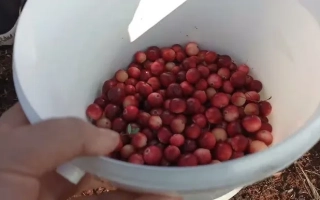
Berries large (up to 0.7 g), round, slightly flattened at poles, bright red, good taste, contain 5-7 medium-sized seeds. Receptacle is round. Berries are consumed fresh and used for processing. Chemical composition of berries: dry matter — 18.5%, total sugars — 7.4%, titratable acidity — 2.0%, ascorbic acid — 38.0 mg/100 g.
Cold-hardy and frost-resistant, has comprehensive resistance to fungal diseases, especially anthracnose. High yield (6-7 kg/plant), stable year-to-year. Self-fertility medium (in natural conditions 32%)
Advantages of the variety: high berry taste quality, disease resistance, easy harvesting due to long and brittle inflorescence pedicel.
Disadvantages of the variety: insufficiently high self-fertility.
Crop & resistance
Crop
Disease resistance
Specifications
| Type of Sort | |
|---|---|
| Catalog | Catalog → Currant |
Not yet комментариев. Be the first!
Alternatives
Currant saplings · similar varieties




See also
Often considered together with this variety





Recently viewed
Products you’ve viewed on this site
Reviews · 0