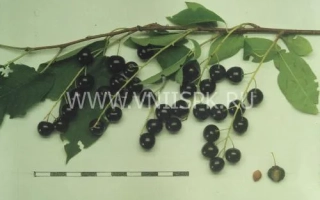
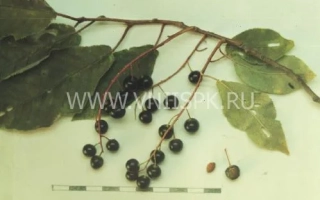
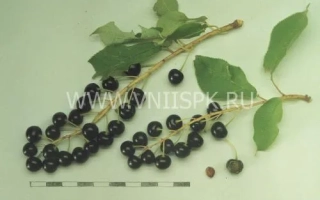
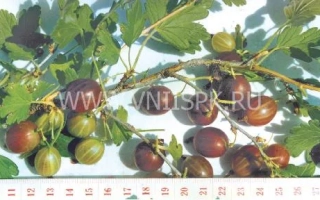
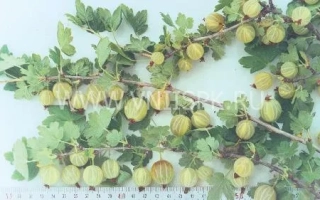
Hybrid from crossing form No. 1-5-13 of Siberian serviceberry with form No. 5-28-10 of cluster serviceberry. Originator — Central Siberian Botanical Garden, SB RAS. Authors: V.S. Simagin, V.P. Belousova, O.V. Simagina. Introduced into the State Register in 2002 for the West Siberian region.
Tree about 8 m tall with a narrow pyramidal crown, densely leafed. Bark grayish, rough. Shoots directed upward, brown, medium thickness, straight; buds numerous, grayish-brown. Vegetative buds medium-sized, narrowly ovate; generative buds ovate, pressed against the shoot. Leaf elliptical, medium-sized, 7.5 x 4 cm, dark green, apex sharply pointed, base rounded, margin finely toothed, no pubescence; leaf blade flat, slightly curved downward; glands 3-4, medium-sized, yellow, bean-shaped; petiole 2 cm long, thin, green. Flowers in dense clusters, 14-15 cm long, 35-40 per cluster, flower diameter 15 mm, corolla saucer-shaped, petals closed, white, round-oval, stigma slightly higher than stamens, calyx broadly cup-shaped, sepals smooth-edged; stamens about 20, 4 mm long, stigma 6 mm long. Flowering on one-year-old shoots.
Fruit weight 0.6-0.7 g, height 7.5 mm, width 7.5 mm, thickness 7.4 mm, round; calyx wide and shallow; apex rounded; skin color at full maturity dark brown, almost black, solid; flesh greenish-yellow, with burgundy veins, tender, juice red; pedicel 0.8 cm long, thin; seed egg-shaped, smooth, 0.05 g, 7% of fruit weight, apex pointed, base rounded, good detachment from flesh.
Fruits are single, attractive. Flesh juicy. Taste sour-sweet with astringency, good, score 4.8. Detachment from pedicel medium. Suitability for mechanical harvesting medium. Resistance to fruit cracking high. General-purpose variety. Fruits suitable for drying, compote, and juice production. Contains 34.8% dry matter, 14.75% sugars, 1.06% free acids, 14 mg/100g ascorbic acid.
Flowering in mid-late season, in Novosibirsk — end of the third decade of May. Ripening mid-late, beginning of August. Enters fruiting on 3-4 years after planting two-year-old saplings. Propagated by green cuttings and grafting. Lifespan of trunk about 30 years. Weakly self-fertile, well pollinated by other selected serviceberry varieties from the Central Siberian Botanical Garden, flowering at similar times. Yield 22-25 kg per tree, at spacing 5 x 3 m, 140-150 centners/ha.
Tree, shoots and generative buds highly resistant to winter frosts. Flowers weakly resistant to spring frosts. Drought and heat resistance medium. Resistance to coccomycosis, clasterosporiosis, and moniliosis high. Resistance to bacterial, viral, and mycoplasma diseases not studied. Resistance to gum exudation and chlorosis medium. Weakly infested by aphids, scale insects, and cherry slugs; heavily infested by serviceberry slugs and hawthorn.
Advantages of the variety: high winter hardiness, good taste and technological qualities of fruits, high and stable yield.
Disadvantages of the variety: high growth, medium fruit size, dense crown.