Hybrid of Viburnum suspensum and Viburnum opulus. Originator — Central Siberian Botanical Garden, Siberian Branch of RAS. Authors: M.N. Salamatov, V.S. Simagin, T.V. Skorokhod. Introduced into the State Register in 1995 for the West Siberian region.
Large tree, 6-7 m tall, with a drooping, broad-pyramidal crown of medium density, densely foliated. Bark is gray-brown and rough. Branches are upward-directed, brown, thick, and straight; buds are numerous, light-brown. Vegetative buds are large, narrowly ovate; generative buds are ovate-egg-shaped and pressed against the branches. Leaf is inversely egg-shaped, very large, 10 x 6 cm, green, apex long-acuminate, base broadly wedge-shaped, margin finely toothed, glabrous; leaf blade flat, slightly curved downward; glands 3-4, large, yellow, bean-shaped; petiole 2.5 cm long, thick, pigmented. Flowers in dense panicles, 12-14 cm long, 40-45 per panicle, flower diameter 15 mm, corolla saucer-shaped, petals almost closed, white, broadly ovate, stigma slightly higher than stamens, calyx broadly cup-shaped, calyx lobes smooth-edged; stamens ~20, 4 mm long, stigma 5 mm long. Flowering occurs on one-year-old branches.
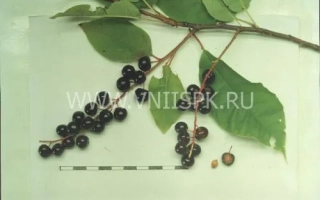
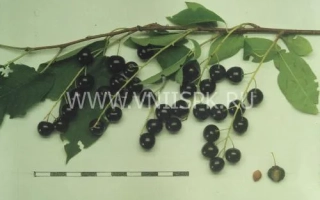
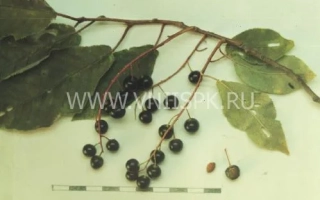
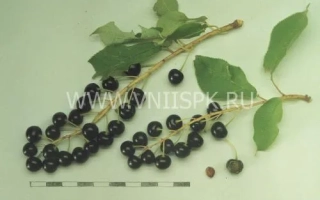
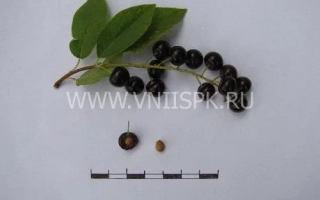
Fruit weight 0.9-1.0 g, height 9.8 mm, width 9.9 mm, thickness 9.0 mm, broadly heart-shaped; cup shallow and small; apex rounded; skin color black, solid upon full ripening; flesh greenish-yellow with dark veins, tender, juice red; pedicel 0.9 cm long, thin; seed egg-shaped, smooth, 0.11 g, 12% of fruit weight, apex acuminate, base rounded, average detachment from flesh.
Fruits are single-seeded, attractive. Flesh is juicy. Flavor is sour-sweet with astringency, good — 4.5 points. Detachment from pedicel is difficult. Suitability for mechanical harvesting is medium. Resistance to fruit cracking is medium. This is a versatile variety. Fruits are suitable for drying, compote and juice production. Fruits contain 33.7% dry matter, 16.3% sugars, 0.8% free acids, 10.4 mg/100g ascorbic acid.
Flowering occurs at medium time, in Novosibirsk — end of the third decade of May. Ripening is medium-early, uniform, in mid-third decade of July. Enters fruiting on the 3rd-4th year after planting two-year-old saplings. Propagated by hardwood cuttings and grafting. Tree lifespan ~40 years. Partially self-fertile, well pollinated by other Viburnum species selected at the Central Siberian Botanical Garden. Yield 18-25 kg per tree, at planting density 5 x 3 m yields 120-165 centners/ha.
Tree, branches, and generative buds are highly resistant to winter frosts. Flowers are weakly resistant to spring frosts. Drought and heat tolerance are medium. Resistance to Coccomyces, Clasterosporium, and Monilinia is high. Resistance to bacterial, viral, and mycoplasma diseases not studied. Resistance to gummosis and chlorosis is medium. Weakly affected by aphids, leaf-feeding sawflies, and cherry slug; strongly affected by viburnum slug and bird cherry.
Advantages of the variety: high winter hardiness, good taste, mass, and technological qualities of fruits, easy propagation, high and stable yield.
Disadvantages of the variety: difficult detachment of fruits.