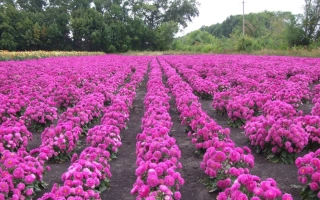
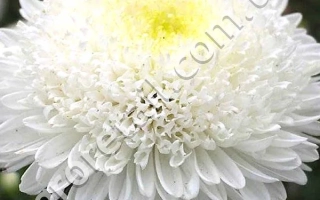
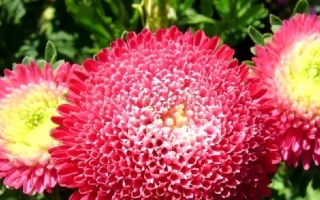
The 'Jubilee White' aster is an annual plant with a compact and sturdy bush reaching up to 70 cm in height. The inflorescences are semi-spherical, densely double-flowered, white in color, featuring narrow, needle-like petals up to 6 cm long and 15 cm in diameter. The flowers are very elegant, forming up to 15 inflorescences on a single plant, arranged on branches of the first and second order. The leaves are green, non-hairy, the peduncles are sturdy, measuring 40-45 cm, which ensures the stability of the inflorescences and their attractive appearance. Blooming begins at the end of July and continues until late autumn, with a flowering duration of approximately 60 days.
The plant is undemanding and resistant to adverse conditions, including frosts down to -3°C and slight shading. The aster tolerates transplanting even during the flowering phase and is characterized by vigorous growth. For successful cultivation, it is recommended to plant in open, sunny areas following a planting scheme of 20x30 cm. Seeds are sown in open ground in April, while for earlier flowering, sowing is conducted in March in greenhouses, followed by transplanting seedlings in May. When sowing, it is important to avoid soil drying out, excessive moisture, and sharp temperature fluctuations.
'Jubilee White' is widely used in greening flower beds and rabatok, as well as being excellent for cutting due to its abundant and prolonged flowering. The plant is resistant to fusarium and does not fade in sunlight, making it a universal variety for various garden compositions. It is not recommended to add fresh organic fertilizers to the soil, as this can negatively affect plant development.