


SKU #3578
·
828 views
Yandikovskoe
Apple
User rating
0 votes0% positive reviews
No ratings yet — be the first.
Type of Sort
Summer apple variety
About product

A summer, excellent local early apple variety, widely grown in the Lower Volga region. It is popular not only in the lower reaches of the Volga and adjacent areas but also in Crimea, where it is considered one of the promising varieties. A variety of folk selection. Its origin is the village of Yandiki in the Limansky District of Astrakhan Oblast. There, it is propagated not only by grafting onto…
Type of Sort
Summer apple variety
Description
A summer, excellent local early apple variety, widely grown in the Lower Volga region. It is popular not only in the lower reaches of the Volga and adjacent areas but also in Crimea, where it is considered one of the promising varieties. A variety of folk selection. Its origin is the village of Yandiki in the Limansky District of Astrakhan Oblast. There, it is propagated not only by grafting onto rootstocks but also by suckers. Rootstock trees have similar morphological features. The local population selected and propagated large-fruited forms with high flavor qualities. During an expeditionary survey of orchards in the Volga delta conducted by the Volgograd Experimental Station of VIR, it was found that this variety has many varieties (clones), from which 30 large-fruited forms were selected. Some clones had a weight of 200-250 g, which will be propagated under the name Yandikovskoe large-fruited, instead of Yandikovskoe, which currently grows in many commercial orchards and among hobbyists — with fruits weighing only 80-150 g.
Trees of medium size, fast-growing in their early years — with a spherical crown, later becoming spreading, dense, and heavily foliated. Main branches diverge from the trunk at a 45° angle, have a curved growth pattern, relatively thin, gray in color, smooth. The fruiting type is mixed: shoots and spear-like branches predominate. Fruit clusters are small, thin, numerous.
Shoots are curved, knee-like, dark brown, covered with numerous small rounded tubercles, some of which are large. Leaf blade is relatively large, long, oval, elongated-oval or elliptical in shape with a rounded or broad-angled base, smoothly tapered tip, finely wrinkled surface on the upper side of the blade and dense woolly pubescence underneath. They are rather flat, relatively even along the main vein, dark green, with smooth or slightly wavy, coarsely toothed single- or double-toothed margins. Petiole is of medium length and thickness. Stipules are narrow-angled or awl-shaped.
Flowers are medium-sized (some are large), white with pale-pink blush. Stigma equals the length of stamens, moderately pubescent, positioned at the level of anthers, styles pubescent only at the base.
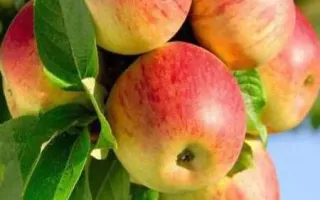
Fruits (fig.) are of medium to large size, one-sided, strongly flattened, round and flat-round, slightly ribbed, slightly one-sided. Skin is smooth. Main color at harvest is light yellow-green, transitioning to cream. Covering blush covers most of the fruit surface or entirely, intense, dense, dark red, with a pattern of stripes and streaks, blending into the background on the sunny side. On the background of the blush, numerous light-colored subcutaneous spots are clearly visible, each surrounded by a small halo. They are rounder near the stem. Surface is smooth, dry to the touch. Calyx is deep, wide, but often medium-sized, slightly compressed from the sides, with a smooth surface. Pedicel is medium-length, central on fruit cluster, short, thin, curved, usually protruding from the calyx. Receptacle is usually half-open, situated in a deep, wide, finely folded dish. Sub-receptacle tube — usually conical, wide, and relatively deep. Axial cavity is narrow, small. Seed chambers are usually closed. Seeds are large, flattened, wedge-shaped, dark brown.
Flesh is white with a cream tint, tender, fine-grained, juicy, aromatic, sweet-tart, excellent flavor. Chemical composition of fruits: dry matter — 15.5% (maximum — 17%), total sugars — 9.9% (12.4%), titratable acids — 0.6% (1.0), ascorbic acid — 5.5 (9.9) mg/100g, sugar-to-acid ratio — 16.6 (26.2).
Fruits ripen in summer, can remain on the tree for some time after harvest without losing their flavor. Typical harvest time is mid to late July. Storage duration does not exceed one to two weeks depending on storage conditions. Fruit quality is high, at 89-92%, including 15-17% of top-grade fruits.
Fruits remain firmly attached to the tree until harvest maturity. Transportability of fruits over short distances is satisfactory.
Fruits are dessert quality, suitable for fresh consumption as well as for processing into juices and dried apples.
Self-sterile, requires pollinators, the best being Anis Alay, Avgustovskoe, Iyulskoe Chernenko.
Trees begin fruiting in the 5th year after planting. They live and fruit for 80-120 years, producing marketable yields. At full fruiting, average yield per tree is 200 kg. Productivity of the variety is relatively high, averaging 150-170 centners/ha over long-term data. High yields are associated with alternate bearing. However, with good nutrition and watering, the variety tends to bear fruit annually.
In northern areas of Volgograd and Saratov Oblasts, trees of this variety may suffer from severe winter frosts. The variety shows relatively high drought resistance and high winter hardiness for southern regions of Russia. They are moderately resistant to powdery mildew and require protection against scab. In dry and hot climates of Kalmykia, Astrakhan, and southern Volgograd Oblast, trees are practically unaffected by scab.
Advantages of the variety: high ecological adaptability to hot climates and frequent dry winds; high yield and excellent fruit flavor, which combine with attractive appearance and appealing coloration.
Fruits are suitable for various processing methods.
Disadvantages of the variety: short shelf life after harvest; in humid southern regions, preventive measures against scab disease are required.
The variety is recommended for breeding as a source of high-yielding, high-quality summer-ripening fruits.
Crop & resistance
Crop
Specifications
| Type of Sort | |
|---|---|
| Catalog | Catalog → Apple |
Store offers
Prices are updated on loadLoading offers…
Aggregator catalog: prices are collected automatically from store websites, normalized by AI and converted at the current exchange rate. Before ordering, confirm the price and availability on the store's website. This block is not indexed by search engines — the data is loaded after the page opens.
Not yet комментариев. Be the first!
Alternatives
Apple saplings · similar varieties




See also
Often considered together with this variety




Recently viewed
Products you’ve viewed on this site
Reviews · 0