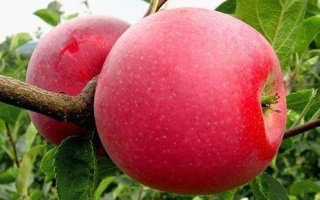
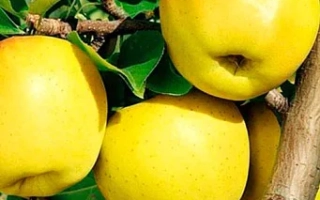
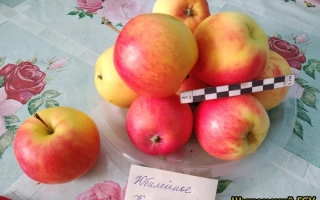
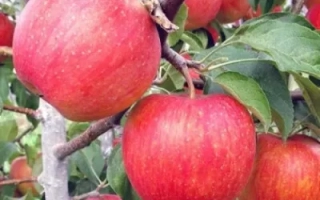
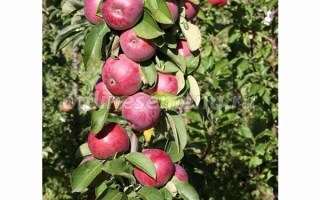
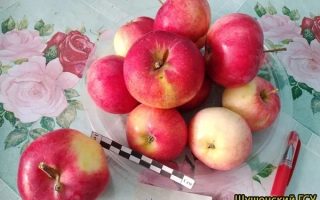
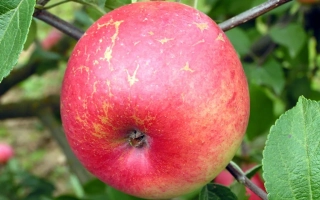
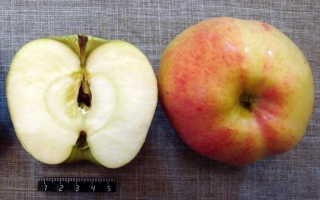
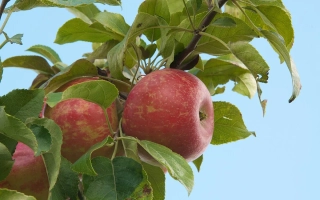
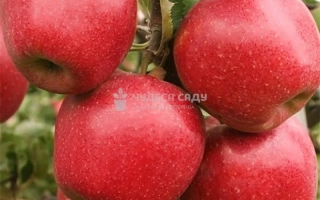
The BAGRYANETS KUBANI apple is a late-winter variety created at the North Caucasus Regional Research Institute of Horticulture and Viticulture in Krasnodar through crossing the Red Delicious and Jonared varieties. The trees are of medium height with restrained growth, featuring round-oval or wide-pyramidal crowns of medium density and foliage. Shoots are of medium thickness, brown, and hairy. The variety is characterized by medium winter hardiness and medium drought resistance, as well as resistance to powdery mildew and medium resistance to scab. Fruiting usually begins in the 5th year, with regularity, especially in mature trees, and a yield of over 35 tons per hectare. The fruits of the BAGRYANETS KUBANI variety are large or above-average in size, relatively uniform, round-conical or flattened-spherical in shape, sometimes oblique or slightly flattened, and mostly symmetrical. The fruit skin at harvest has a greenish-yellow base with a blurred dark-red or dark-crimson blush, which acquires a purple hue when harvested late in early October. The flesh is creamy, often with a pink or light-crimson hue under the skin, dense, fine-grained, and juicy. The taste is sour-sweet, pleasant, with a dessert character and a medium aroma, confirmed by a high taste tasting score from 4.4 to 4.7 points. The fruits ripen in the second half of September and can be stored until April, and they are not prone to shedding. To ensure better fruiting, the presence of pollinators such as Prykuban, Aidor, Golden Delicious, or Florina is recommended. The fruits have good transportability and an attractive appearance, making the variety in demand for cultivation in southern regions of Russia. However, under heavy crop load and in dry years, the fruits may become smaller.