
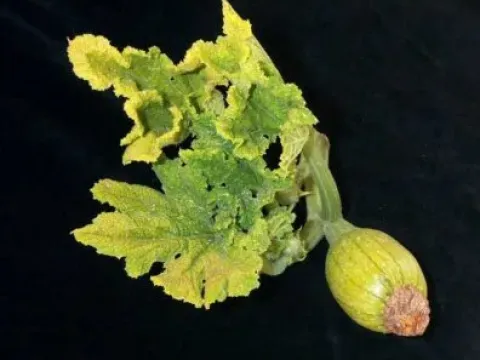
Watermelon curly mottle
Watermelon curly
The primary symptom of Watermelon curly mottle is a distinct curling and wrinkling of the leaf blades, which often appear distorted and puckered.
What the section contains
Watermelon curly mottle
Infected leaves frequently show a mosaic-like pattern with intermingled light and dark green patches, indicating a disruption in chlorophyll distribution.
Stunted plant growth is a common observation, where internodes shorten and the plant exhibits a bushy, rosette-like appearance instead of normal vine development.
Flowering is significantly reduced or inhibited, and the few flowers that do develop often result in misshapen, small, or aborted fruits that are commercially useless.
Plants affected at an early stage may cease to grow entirely, with new growth appearing as a cluster of severely stunted and crumpled leaves at the crown.
The disease is caused by viruses belonging to the Begomovirus genus (family Geminiviridae), characterized by circular single-stranded DNA genomes.
These viruses rely on insect vectors, primarily the whitefly (Bemisia tabaci), to transmit the pathogen from infected host plants to healthy watermelon crops.
The viral particles enter the plant tissue through the feeding activity of the vector and rapidly move into the phloem to distribute throughout the plant.
Once systemic infection occurs, the virus interferes with the host's hormonal balance and metabolic pathways, specifically targeting the photosynthetic machinery.
Persistence of the virus within the insect vector is a critical factor, allowing the whitefly to transmit the disease over long distances and extended periods.
Warm and dry weather conditions are highly conducive to the population explosion of whiteflies, which in turn spikes the transmission rate of the virus.
High temperatures combined with optimal humidity levels create a favorable environment for the rapid reproduction of the vector population in the field.
Weed hosts in the surrounding areas, especially those belonging to the Cucurbitaceae and Solanaceae families, act as major reservoirs for the virus during the off-season.
Dense crop spacing and poor ventilation within the canopy can encourage the accumulation of insect populations, leading to severe localized outbreaks.
Plants that are stressed due to inadequate water supply or nutrient imbalances are generally more susceptible to viral invasion and exhibit more severe symptom expression.
Watermelon curly mottle disease can be devastating, causing total loss of fruit production if the plants are infected during the early vegetative stage.
The commercial quality of the fruit is severely degraded, as infected plants produce melons with poor sugar content, inconsistent texture, and distorted shapes.
The reduction in foliage density exposes the developing fruit to direct sunlight, causing severe sunscald and further decreasing the market value of the harvest.
Economic impacts include not only the loss of potential yield but also the high costs associated with continuous chemical control measures for the vector population.
Because there is no cure for established viral infections, infected plants must be removed, which significantly reduces the final plant stand count per hectare.
Effective management requires a strict integrated pest management (IPM) program focused on controlling whitefly populations through systemic insecticides.
Crop sanitation is essential; removing weed hosts in and around the fields is a critical preventative measure to reduce the initial inoculum of the virus.
The use of reflective mulches can help repel adult whiteflies, interfering with their ability to locate and land on the young watermelon plants.
Producers should use spatial isolation, planting new watermelon crops away from older or infected fields to reduce the risk of vector movement.
Early identification of symptomatic plants and their immediate removal is the most effective way to curb the spread of the virus within an otherwise healthy crop.