
Rice tungro virus
Waikavirus oryzae
The causative agent of this disease is the Rice tungro virus, which belongs to the genus Waikavirus, family Secoviridae. It is a viral pathogen that poses a serious threat to rice production.
What the section contains
Rice tungro virus
Tungro disease typically manifests as a complex involving two distinct viral particles: Rice tungro spherical virus (RTSV) and Rice tungro bacilliform virus (RTBV).
The virus cannot be transmitted through seeds or soil. It requires a specific insect vector, primarily the green leafhopper, to migrate from infected to healthy plants.
The virus persists in the environment within perennial weeds and rice stubble, which serve as reservoirs between consecutive growing seasons.
Once inside the plant, the virus localizes in the phloem tissue, disrupting the translocation of nutrients and causing systemic metabolic disturbances throughout the host.
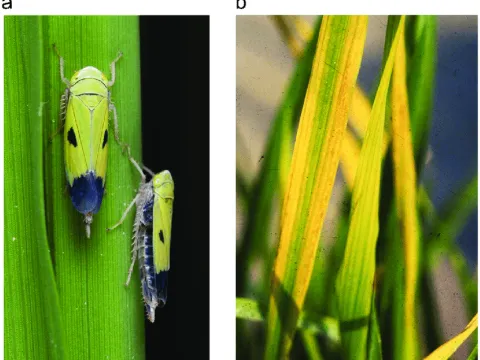
The first clinical signs of Tungro include yellowing or orange discoloration of leaves, which starts from the leaf tip and progresses downwards along the leaf blade.
Infected rice plants show significant stunting, with a height much shorter than that of healthy plants, giving the field an uneven and dwarfed appearance.
The tillering capacity of affected plants is severely compromised, resulting in fewer shoots and a thinner stand density in infected areas of the field.
Generative development is also impacted, leading to incomplete or deformed panicles that may produce sterile or discolored grains, significantly reducing overall yield.
- Yellowing of leaves
- Severe stunting
- Reduced tillering
- Deformed panicles
- Grain sterility
The primary vector for the virus is the green leafhopper, Nephotettix virescens, which acquires the virus by feeding on the sap of infected plants.
Continuous rice cropping systems, common in tropical regions, provide an uninterrupted supply of host plants, which facilitates the rapid multiplication of leafhoppers.
High humidity and optimal temperatures promote higher activity and population density of the vector, leading to faster transmission rates of the viral disease.
Poor agricultural practices, such as excessive nitrogen application, can make the rice plants more attractive to leafhoppers and more susceptible to viral invasion.
Staggered planting schedules in a shared agricultural area allow the virus to move easily from mature, infected plants to newly transplanted young seedlings.
Rice tungro virus is considered one of the most destructive diseases in rice-growing regions, potentially causing complete crop failure during major outbreaks.
Economic losses are severe, stemming from both the reduction in grain weight and the deterioration of grain quality, which impacts its market value and usability.
Early infection during the seedling stage can lead to plant death, significantly reducing the stand density and the ultimate harvestable yield per hectare.
Because the disease spreads rapidly through the movement of vectors, localized infections can quickly escalate into widespread epidemics, threatening food security.
The costs associated with managing the vector population through chemical pesticides add a significant burden to the overall production costs for rice farmers.
The most effective long-term management strategy is the use of resistant rice cultivars that either prevent viral infection or suppress the feeding of leafhoppers.
Application of systemic insecticides during the critical early growth stages helps in controlling the leafhopper population and preventing the initial spread of the virus.
Synchronizing planting dates within a specific region is a crucial preventive measure that breaks the cycle of virus transmission between different generations of rice.
Sanitation practices, including the eradication of weeds and the destruction of infected rice stubble, help remove reservoirs of the virus and the vector.
Regular surveillance using light traps allows farmers to monitor the influx of leafhoppers and take timely actions before the virus becomes widely established.