
Rice tungro disease
Tungrovirus oryzae
Rice tungro disease is a serious viral infection caused by the combined action of two distinct viruses: the Rice tungro spherical virus (RTSV) and the Rice tungro bacilliform virus (RTBV).
What the section contains
Rice tungro disease
The disease cannot be transmitted through soil or seeds; it relies entirely on insect vectors, primarily green leafhoppers, to move between host plants.
Once the leafhopper feeds on an infected plant, it acquires the virus and can transmit it to healthy rice seedlings almost immediately during the next feeding event.
RTBV is the primary agent causing the characteristic severe symptoms, while RTSV assists in the efficient transmission by the insect vectors.
The virus impacts the vascular tissue of the rice plant, severely disrupting nutrient transport and photosynthesis efficiency across the entire organism.
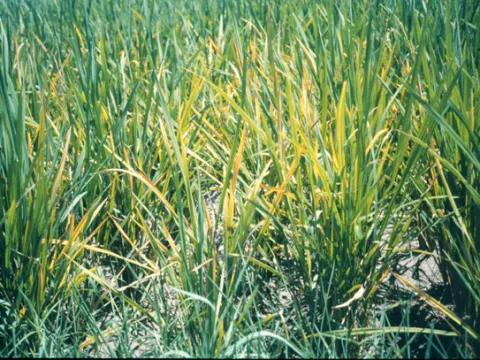
Initial symptoms are characterized by leaf discoloration, which transitions from light green to yellow or orange, typically starting at the leaf tips.
Stunting is the most prominent symptom, as infected plants remain significantly shorter compared to healthy ones, particularly when infection occurs early.
The number of tillers per hill is drastically reduced, leading to a sparse appearance of the crop and a poor stand establishment in the field.
Panicle formation is usually delayed, and the resulting panicles are often small, sterile, or fail to emerge, which leads to substantial yield losses.
Infected roots appear poorly developed and have a reduced capacity for nutrient uptake, further compromising the plant's overall vitality and growth.
The disease incidence is heavily dependent on the population dynamics of leafhoppers, which thrive in warm and humid tropical environments.
Continuous rice cropping systems, where rice is grown throughout the year, provide a perpetual source of inoculum for the virus to circulate.
Dense planting and excessive use of nitrogen fertilizers promote lush growth, making the plants more attractive and susceptible to leafhopper infestations.
Nearby weedy areas or fallow fields serve as crucial reservoirs, harboring both the virus and its vectors between planting seasons.
High temperatures accelerate the life cycle of the leafhoppers and increase the speed of viral replication within the plant tissues.
Rice tungro disease is recognized as one of the most destructive constraints to rice production, causing significant economic losses globally.
Yield losses can range from minor impacts in tolerant varieties to complete crop failure in highly susceptible fields during severe outbreaks.
The disease not only reduces the quantity of the harvest but also negatively affects the milling quality and nutritional value of the rice grain.
Farmers face substantial financial burdens due to the need for frequent pesticide applications to control vector populations during the early stages.
The presence of the virus forces producers to adopt more expensive, resistant varieties, which may require different agronomic management practices.
The primary strategy for managing tungro is the utilization of resistant rice cultivars, which act as the first line of defense against the virus.
Strategic timing of insecticide applications to reduce leafhopper populations is essential to prevent secondary spread within the rice field.
Implementing synchronized planting across regions helps to break the life cycle of the vectors and limits the window for infection.
Sanitation practices, including the removal of infected plant residues and weeds, help to reduce the primary sources of viral inoculum in the landscape.
- Use of yellow sticky traps to monitor leafhopper migration.
- Applying balanced fertilization to improve plant vigor.
- Establishing host-free periods to interrupt the virus transmission cycle.