
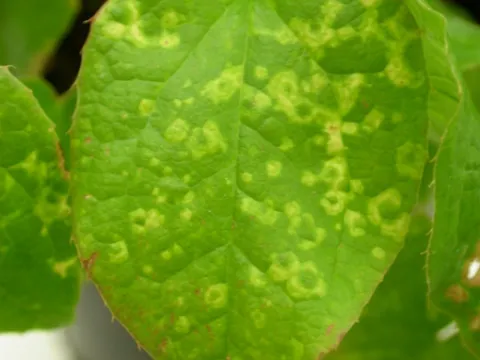
Tobacco rattle virus
Tobravirus tabaci
The Tobacco rattle virus (TRV) is the type species of the genus Tobravirus. It is a single-stranded RNA virus with a bipartite genome, meaning its genetic material is divided into two separate particles of different lengths.
What the section contains
Tobacco rattle virus
For a successful infection to occur, the plant must be inoculated with both types of particles, as the viral genome is only complete when both components are present.
The virus is primarily transmitted by soil-dwelling stubby root nematodes belonging to the genera Trichodorus and Paratrichodorus. These vectors acquire the virus by feeding on infected roots.
TRV has an exceptionally wide host range, including both monocotyledonous and dicotyledonous plants, making it a difficult pathogen to eradicate in diverse agricultural landscapes.
The virus particles are highly stable in the environment and can persist in the soil for years, both within the bodies of their nematode vectors and in associated plant debris.
Symptoms of TRV infection vary greatly depending on the plant species, cultivar, and environmental conditions, often appearing as distinct patterns on foliage.
In tobacco, the virus causes the classic "rattle" symptom, characterized by necrotic or chlorotic spots and irregular mosaic patterns that often lead to leaf distortion.
In potato tubers, the disease is known as "corky ringspot." It manifests as dark, necrotic rings or arcs on the surface and brown, corky lesions within the flesh of the tuber.
Infected plants frequently exhibit stunted growth, reduced leaf size, and a general lack of vigor, which significantly impairs their ability to produce healthy yields.
In some ornamental crops, the virus induces flower breaking or irregular color patterns, which, while sometimes prized in nature, generally marks the plant as severely diseased.
TRV infection is closely linked to the ecology of its nematode vectors. These organisms thrive in sandy or light, well-drained soils with adequate moisture levels.
Environmental factors that favor nematode activity, such as moderate soil temperatures and high soil moisture, generally correlate with increased incidences of viral transmission.
Weeds growing in or around fields often serve as asymptomatic reservoirs, allowing the virus to survive and persist even when the primary crop is absent.
Agricultural practices that facilitate the movement of soil, such as the use of contaminated machinery or the movement of nursery stock, play a key role in spreading the virus.
A history of poor crop rotation, particularly where susceptible hosts are grown sequentially, encourages the buildup of nematode populations and increases the likelihood of an outbreak.
The economic impact of TRV is significant, particularly in the potato industry, where internal tuber necrosis renders the harvest unmarketable and causes heavy financial losses.
Beyond direct yield loss, the virus weakens plants, making them more susceptible to opportunistic pathogens, thereby increasing the costs associated with secondary treatments.
In high-value ornamental crops, the presence of TRV can lead to the total loss of aesthetic quality, forcing producers to destroy entire batches of infected plants.
The persistent nature of the virus in the soil can render specific fields unfit for the cultivation of high-value, susceptible crops for several years.
Managing TRV is further complicated by its ability to hide in various perennial weed hosts, making complete field eradication extremely challenging.
The primary control measure is the use of high-quality, virus-indexed seed potatoes and nursery stock to ensure that the disease is not introduced into clean soil.
Implementing a rigorous crop rotation program that includes non-host crops can help reduce nematode populations and break the disease cycle.
- Thorough weed control to eliminate alternative viral hosts.
- Sanitizing farm machinery before moving from infested fields to clean areas.
- Selecting resistant or tolerant cultivars when available.
- Applying nematicides as a last resort in heavily infested fields to reduce vector density.
Regular phytosanitary inspections help in the early identification and removal of symptomatic plants, preventing further localized spread within the field.
Soil fumigation or solarization can be used in some contexts to reduce nematode levels, though these methods are often expensive and logistically demanding.