
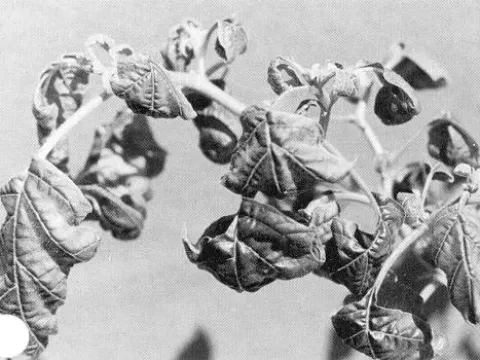
Tobacco streak virus (Mastrevirus tabaci)
Mastrevirus tabaci
The causative agent of the disease is a virus belonging to the Mastrevirus genus, which primarily affects plants of the Solanaceae family. This pathogen contains single-stranded DNA and triggers systemic infections in the host plant.
What the section contains
Tobacco streak virus (Mastrevirus tabaci)
The virus biology is intrinsically linked to its insect vectors, mainly leafhoppers. While feeding on the phloem of infected plants, these insects acquire viral particles and subsequently transmit them to healthy plants during their feeding cycle.
The viral capsid possesses structural stability, which contributes to the pathogen's ability to survive effectively within the host environment. Mechanical transmission or seed transmission is relatively rare for this specific type of Mastrevirus, emphasizing the role of insect vectors.
As a systemic pathogen, the virus spreads through the phloem, effectively colonizing the entire plant organism. This colonization disrupts essential metabolic functions, including nutrient translocation and photosynthetic activity, which leads to the characteristic stunted growth of the host.
The overall spread of the disease is strictly dependent on the population density of the insect vectors. Since the virus does not persist in the soil for long periods, reservoirs like weeds and overwintering insect populations are crucial for the annual recurrence of the disease.
The initial symptoms are characterized by the appearance of chlorotic streaks or mosaic patterns on young leaves. Over time, these patches can coalesce, significantly reducing the leaf area available for photosynthesis and affecting the plant's overall vitality.
Affected plants exhibit clear growth retardation, including leaf curling, deformation, and shortened internodes. This condition gives the plant a stunted or dwarfed appearance, which is particularly evident in fields where infection spreads early in the season.
A distinct feature of the streak virus is the change in vein color, where veins may become yellow or chlorotic against the leaf background. This specific pattern creates a noticeable streaked or striped look that distinguishes it from other common viral infections of tobacco.
Reproductive organs are also severely impacted by the virus. Plants may fail to develop healthy flowers, and seed production is frequently compromised. This is especially detrimental for commercial seed production and the overall harvest potential of the crop.
- Chlorotic streaks on young leaves
- Mosaic patterns and discoloration
- Leaf deformation and curling
- Stunted growth and shortened internodes
- Reduced flower fertility and seed yield
Outbreaks of the tobacco streak virus are most frequent during periods of high leafhopper activity. Dry, warm weather conditions create an ideal climate for the multiplication and rapid migration of vectors between healthy and infected plants.
Optimal temperatures for the virus replication usually range between 20°C and 25°C. Under these conditions, the incubation period is shortened, leading to rapid symptom manifestation once the virus is introduced into the plant tissue.
The presence of wild reservoir weeds surrounding tobacco fields provides a constant source of infection. Insects build up the viral load on these weeds before moving into the high-value tobacco crops, often starting from the field edges.
Neglecting basic agronomic practices, such as weed control, significantly increases the risk of an epidemic. If a field is heavily infested with weeds, the vectors have an uninterrupted food supply, maintaining a continuous cycle of viral transmission.
The lack of early monitoring for pest populations often leads to delayed detection, allowing the virus to establish itself throughout the crop. Early diagnostic measures and prophylactic field checks are essential to mitigate the impact of the disease.
The primary damage lies in the drastic reduction of leaf quality, which is the most valuable output of tobacco farming. Infected leaves lose their elasticity and texture, making them unsuitable for high-quality curing and fermentation processes.
Severe infections lead to a substantial loss in total biomass yield. The plants do not achieve their standard size, and their chemical composition, including sugar and nicotine content, is often altered, making the leaf undesirable for industrial processing.
Infected plants become highly susceptible to secondary pathogens, including fungal and bacterial infections. This predisposes the crop to premature senescence and death, leading to significant economic losses for the farmer due to harvest failure.
Economic losses include not only the loss of potential yield but also the high costs associated with pest control and the removal of infected plants. In some cases, whole plots may become unprofitable, requiring long-term quarantine measures for the affected areas.
Strict international standards often prohibit the use of raw tobacco with symptoms of viral disease. This limits market access for affected farms, potentially causing severe reputational and financial damage to the tobacco production industry.
The primary control strategy involves rigorous weed management, particularly focusing on the removal of solanaceous weeds that act as virus reservoirs. Maintaining clean fields significantly reduces the pressure of the pathogen at the beginning of the season.
Application of systemic insecticides is vital for controlling leafhopper populations during high-risk periods. Reducing the number of insect vectors effectively halts the horizontal transmission of the virus, preventing it from spreading across the field.
Using certified, disease-free planting material is a mandatory requirement. While transmission is primarily by insects, starting with healthy transplants minimizes the risk of introducing the virus into new, clean production areas.
Implementing spatial isolation between fields and following proper crop rotation patterns disrupts the virus transmission cycle. Avoiding the placement of new tobacco plots near areas with recent infection history is a standard risk-mitigation practice.
The long-term solution lies in breeding and introducing virus-resistant tobacco varieties. Relying on genetic resistance is the most sustainable and environmentally friendly approach to managing viral diseases, drastically reducing the need for intensive chemical applications.