
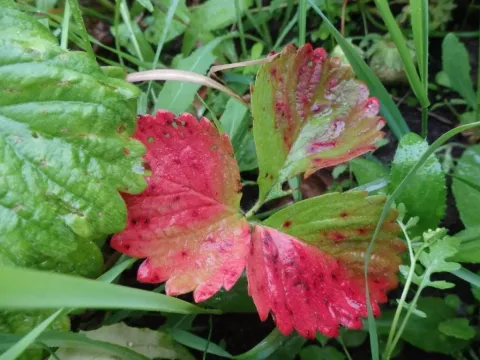
Strawberry leaf scorch
Strawberry leaf
The disease is caused by the fungus Marssonina fragariae, which is the anamorph stage of the ascomycete Diplocarpon earlianum.
What the section contains
Strawberry leaf scorch
The pathogen overwinters primarily in dead leaf tissue or on infected crowns, surviving as mycelium or as sporulating structures ready for release in the spring.
Dissemination of the pathogen occurs through conidia, which are dispersed primarily by splashing water from rainfall or irrigation systems.
It is a host-specific parasite that focuses its attack on cultivated and wild strawberry species, hindering their physiological processes.
The life cycle is closely tied to moisture levels, with the fungus requiring consistent humidity to complete its infection and reproduction cycle on the host plant.
Initial symptoms manifest as small, dark purple to reddish-brown spots on the upper surfaces of the leaves, which expand as the infection progresses.
As the spots age, they often develop irregular margins, and the centers may exhibit tiny blackish specks, which are the acervuli containing fungal spores.
In severe infections, the spots coalesce, causing entire leaves to turn brown, wither, and eventually drop off, giving the plant a scorched appearance.
The disease also targets leaf stalks (petioles), flower stalks (pedicels), and calyxes, leading to necrotic tissue and potential fruit decay.
Plants affected by the fungus exhibit overall weakness, stunted growth, and significantly reduced vigor due to the loss of photosynthetic area.
The development of leaf scorch is highly dependent on wet weather conditions, as prolonged rainfall creates the perfect environment for spore germination.
Warm temperatures, typically ranging from 18°C to 25°C, coupled with high humidity, significantly accelerate the spread of the fungus through the strawberry field.
Poor ventilation within the strawberry rows, caused by overcrowding or lack of maintenance, prevents leaves from drying out and encourages fungal establishment.
Inadequate field hygiene, such as leaving infected crop debris on the ground, acts as a primary source of inoculum for subsequent seasons.
Overhead irrigation systems can inadvertently simulate rainfall, keeping the canopy wet for too long and facilitating the transmission of the disease.
The primary economic impact involves a significant decrease in berry yield and quality, as weakened plants struggle to produce full-sized, sweet fruits.
Continuous infection leads to the premature loss of leaf area, which prevents the plant from accumulating sufficient energy stores for the next season's crop.
Plants severely weakened by the disease are significantly more susceptible to winter injury, as they lack the vigor needed to survive freezing temperatures.
The longevity of a commercial strawberry patch is drastically reduced, often forcing growers to rotate fields much earlier than planned.
Defoliated plants show a reduced capacity for runner production, which negatively impacts the propagation of high-quality planting material.
Effective management begins with the use of disease-free planting stock sourced from reputable nurseries to prevent initial field infection.
Sanitation practices are critical: promptly removing and destroying infected foliage after the harvest cycle helps minimize the overwintering population of the fungus.
Planting strawberries in well-spaced rows improves airflow, allowing the foliage to dry rapidly after rain and reducing the likelihood of fungal infection.
Preventative applications of fungicides, particularly those based on copper, can be effective if applied during the early season and immediately post-harvest.
- Practice regular crop rotation to avoid pathogen buildup in the soil.
- Ensure proper field drainage to prevent localized high-humidity zones.
- Maintain plant health with balanced fertilization to boost natural resistance against pathogens.