
Strawberry ring spot virus
Sadwavirus fragariae
Description
Symptoms
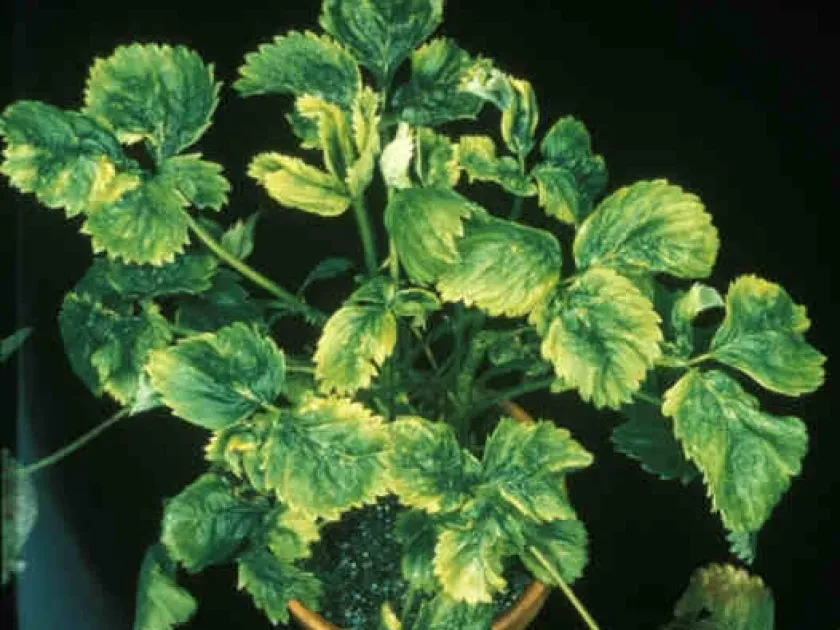
Initial symptoms include chlorotic spots or characteristic ring-like patterns appearing on strawberry leaves. Over time, these small, pale dots enlarge and evolve into distinct rings or semi-circular patterns.
Affected plants often exhibit leaf deformation, with edges curling and the leaf blade puckering. Stunting is a common sign, with infected bushes showing significantly reduced growth compared to healthy neighboring plants.
Flower stalks of infected plants are typically shortened, leading to a dramatic drop in yield. The berries produced are often small, misshapen, or fail to develop entirely, causing substantial commercial losses throughout the season.
As the infection progresses, the plant's immune system weakens, leaving it susceptible to secondary fungal pathogens. Infected strawberry plants also struggle to withstand environmental stressors, such as frost or drought.
Many varieties can host the virus in a latent state, where visual symptoms are absent. Despite the lack of obvious signs, these plants continue to act as active sources of infection, spreading the virus through the soil to neighboring plants.
Pathogen
The Strawberry ring spot virus (Sadwavirus fragariae) is a soil-borne viral pathogen that causes systemic infections in host plants. It can persist for long periods in the plant's root system and the surrounding rhizosphere.
This pathogen is an obligate parasite, multiplying exclusively within the living tissues of its host. Unlike some other viruses, it does not spread mechanically through pruning tools or sap, but relies on specific vectors for transmission within the field.
The disease type is characterized as a viral infection, which often presents in a latent or chronic form. The virus invades the plant's vascular system, gradually spreading to all organs, including leaves and roots, thereby disrupting vital metabolic functions.
The biology of the pathogen is intrinsically linked to the activity of soil-dwelling nematodes. These vectors transmit the virus while feeding on plant roots, making it an extremely persistent threat in agricultural environments.
The virus possesses high genetic adaptability, allowing it to survive inside its nematode vectors for extended durations. This results in established reservoirs of infection that can persist in the soil even in the absence of a host crop.
Conditions for development
The spread of the virus is primarily driven by the presence of specific nematode vectors, such as species from the genera Longidorus or Xiphinema. These micro-pests move through the soil and transmit the virus during root feeding.
Disease development is favored by moderate soil moisture and the presence of suitable host roots. Infestations are most common on land that previously supported susceptible host crops or reservoir weeds.
The use of infected planting stock is the most critical factor in the introduction of the virus to new areas. Since the virus is systemic, it resides inside plant tissues and is not easily detectable through visual inspection during selection.
Soil temperature and moisture significantly influence vector activity. Spring and autumn seasons often see the highest rates of viral transmission as nematodes become more active in the soil profile.
Continuous strawberry cultivation on the same site without proper crop rotation leads to the buildup of nematode populations, which significantly exacerbates the severity of viral outbreaks.
Why it matters
The main impact of this virus is a significant reduction in berry quality and total plantation productivity. Infected bushes quickly lose their vitality and yield potential, requiring early removal and replanting.
Economic losses include the costs associated with destroying infested fields and the implementation of rigorous quarantine protocols. Commercial production on contaminated sites often becomes unsustainable and high-risk.
The virus suppresses the root system, hindering the uptake of essential nutrients and water. This leads to chronic chlorosis and the gradual collapse of individual plants or entire sections of the berry field.
The inability to use infested sites for nursery production or propagation creates severe bottlenecks for growers looking to renew their cultivars, thereby slowing the adoption of modern berry varieties.
The latent nature of the infection is particularly dangerous, as visually asymptomatic plants can act as hidden reservoirs. This often leads to widespread transmission throughout the plantation before the grower becomes aware of the problem.
Protection
The primary control strategy involves using only healthy, certified planting material produced through tissue culture techniques and tested in specialized laboratories for the absence of viral pathogens.
A crucial agronomic measure is strict crop rotation. It is strongly advised against planting strawberries in fields known to have high nematode populations or that have recently held crops susceptible to similar viruses.
Before establishing a new plantation, soil analysis for nematode presence is highly recommended. If infestation levels are high, soil fumigation or extended fallow periods should be employed to reduce vector populations.
- Maintaining adequate spatial isolation between new plantings and old infested fields.
- Promptly identifying, removing, and disposing of any plants showing symptoms.
- Implementing regular weed management to remove alternative viral hosts.
- Selecting strawberry varieties that exhibit improved viral resistance or tolerance.
If a disease outbreak is detected, affected plants must be removed immediately along with the surrounding root zone. Subsequent quarantine measures, such as planting non-host cover crops, are necessary to clean the soil before replanting.
Discussion
No discussions yet — be the first.