
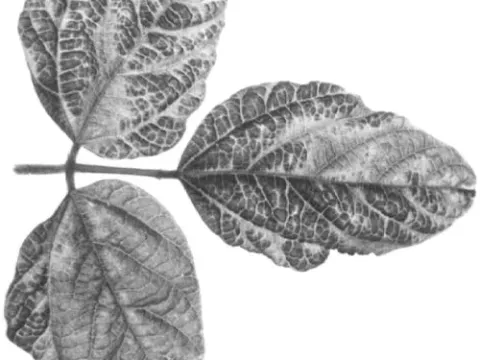
Soybean crinkle leaf virus
Soymovirus crispocestri
The causal agent is the Soybean crinkle leaf virus, classified within the Soymovirus genus, which is a significant pathogen for leguminous crops.
What the section contains
Soybean crinkle leaf virus
This virus is characterized by a bacilliform particle structure and belongs to the Caulimoviridae family, known for its specific infection cycle in host plants.
The virus acts systemically, moving through the phloem to disrupt the physiological functions and developmental pathways of the soybean plant.
Insects, particularly those that feed on plant sap, serve as the primary vectors for viral transmission in field environments.
The virus can persist in perennial weed species, allowing it to survive off-season and reinfect new soybean crops during the following growing cycle.
The most distinctive symptom is the severe crinkling and distortion of leaf blades, which results in a reduction of the total photosynthetic leaf area.
Infected plants often display a mosaic-like pattern on their leaves, characterized by alternating patches of chlorotic and normal green tissue.
Stunting of the entire plant is commonly observed, with affected individuals failing to reach the growth heights and biomass typical of healthy plants.
Reproductive success is severely compromised, manifesting as blossom drop and the formation of deformed, stunted, or completely sterile pods.
Internode shortening contributes to a compact, distorted appearance of the plant canopy, which is a clear indicator of systemic viral infection.
Favorable conditions for the virus include warm and dry weather, which promote the rapid reproduction and migration of the insect vector populations.
Spread usually originates from field edges, as vectors move from neighboring wild plant reservoirs into the soybean fields.
High plant density and insufficient weed control create a stable environment that facilitates the continuous transmission and spread of the pathogen.
Environmental stress, such as moisture deficiency or nutrient imbalances, exacerbates the severity of the symptoms and lowers plant resistance.
The temporal overlap of peak vector activity and the susceptible stage of plant development is a critical factor in the severity of an outbreak.
The primary economic impact is a significant yield loss, as infected plants suffer from reduced pod set and poor grain filling.
Grain quality is drastically reduced, affecting both oil and protein content, which lowers the overall market value of the soybean harvest.
The virus compromises the plant's natural defenses, making the crop significantly more susceptible to opportunistic secondary infections by fungi and bacteria.
Seeds harvested from virus-infected fields exhibit poor germination rates and low vigor, making them unsuitable for future planting operations.
Production costs increase as farmers are forced to implement aggressive vector control measures to save the remaining unaffected crop.
The deployment of genetically resistant or tolerant soybean varieties is the most sustainable and effective strategy for long-term disease management.
Systemic insect control via insecticide application is necessary to break the transmission cycle by limiting the activity of the insect vectors.
Maintaining clean field borders by removing weeds and wild legumes is essential to eliminate the primary viral reservoirs near the production area.
Regular field scouting and the rogueing of symptomatic plants can help to slow the spread of the virus within the crop population.
- Use certified virus-free seed stock.
- Implement robust crop rotation to disrupt host-vector cycles.
- Monitor vector populations with yellow sticky traps.