
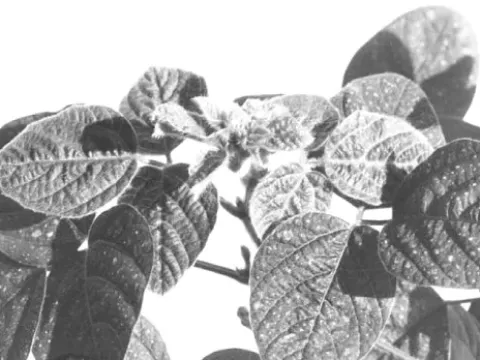
Soybean chlorotic mottle virus
Sobemovirus scmov
The causal agent of this disease is the Sobemovirus scmov (Soybean chlorotic mottle virus), which belongs to the genus Sobemovirus. It is a single-stranded RNA virus that specifically targets legumes.
What the section contains
Soybean chlorotic mottle virus
As an obligate parasite, the virus requires living plant cells to replicate. It hijacks the host's cellular machinery to produce viral components, leading to physiological stress within the plant.
The virus particles (virions) are small, isometric, and lack an envelope. This structural simplicity contributes to their stability in various environmental conditions and persistence in crop residues.
Transmission occurs primarily through mechanical inoculation or via specific insect vectors, such as aphids, which feed on the sap of infected plants and transfer the virus to healthy ones.
The virus is known for its ability to persist in wild legume reservoirs, providing a constant source of inoculum that can enter soybean fields whenever environmental conditions become favorable.
The most characteristic symptom is chlorotic mottling, where leaves show a variegated pattern of yellow and green spots. This occurs due to the breakdown of chlorophyll in the infected tissues.
Stunting is a common sign, as the viral infection interferes with the plant's hormonal balance, resulting in significantly shorter stems compared to healthy plants in the same field.
Affected leaves may exhibit curling, wrinkling, or other deformities. In severe cases, the foliage might show premature yellowing, leading to early senescence of the plant's lower canopy.
Reproductive development is also impacted, with a reduction in the number of flowers and pods. The pods that do form are often underdeveloped or fail to reach their full grain potential.
- Chlorotic mottling on leaves
- Stunted plant growth and development
- Leaf deformation and curling
- Reduction in pod count and seed yield
Favorable temperatures for viral replication typically range between 20°C and 28°C. During these conditions, the virus spreads more rapidly within the soybean tissue.
The presence of insect vectors is the primary driver of rapid field-wide spread. High populations of aphids or leafhoppers during the vegetative stage drastically increase infection rates.
Dense crop stands with poor air circulation can promote higher insect activity, which in turn facilitates the quick transmission of the virus from one plant to the next.
Weed-rich environments surrounding fields provide refuge for both the virus and its vectors. These reservoirs act as the initial point of contact for the virus in the spring.
Mechanical damage caused by farm equipment during field operations can create entry points for the virus, especially in fields where the disease is already present in isolated patches.
The economic impact of Soybean chlorotic mottle virus includes a substantial decrease in grain yield, often ranging from 15% to 40% depending on the timing of the initial infection.
Seed quality is adversely affected; infected plants produce smaller, shriveled seeds that have lower oil and protein content, directly impacting marketability and processing quality.
The virus weakens the plant's systemic resistance, making it more susceptible to opportunistic fungal and bacterial pathogens, which further complicates crop management.
Long-term soil health can be impacted if infected crop debris is not managed correctly, as the viral load can accumulate in the field over several growing seasons.
The reduction in photosynthetic efficiency means that despite adequate fertilization, the crop cannot convert nutrients into biomass effectively, resulting in poor harvest results.
The most effective strategy is the use of resistant or tolerant soybean varieties, which can maintain acceptable yields even when the virus is present in the environment.
Aggressive weed management in and around fields is essential to eliminate reservoirs where the virus and vectors survive during the off-season.
Monitoring for insect vectors and applying timely insecticide treatments can significantly reduce the secondary spread of the virus within the soybean population.
Crop rotation practices should be implemented to break the life cycle of the virus, avoiding the cultivation of susceptible hosts in the same field for consecutive years.
Maintaining good field hygiene, including the cleaning of equipment after moving from infested areas, helps prevent the mechanical transfer of viral particles across different sections of the farm.