
Ryegrass mosaic virus
Rymovirus lolii
The causative agent of the disease is the Ryegrass mosaic virus (RMV), a member of the Macluravirus genus. It is a single-stranded RNA virus that primarily infects perennial grasses, especially those in the Lolium genus.
What the section contains
Ryegrass mosaic virus
The viral particles appear as flexible filaments under an electron microscope, which is a hallmark of this pathogen group. The virus exhibits a high degree of host specificity, focusing on species within the Poaceae family.
The primary vector for the virus is the eriophyid mite Abacarus hystrix. This mite is essential for the epidemiology of the disease, as the virus does not spread effectively through mechanical contact or seed transmission in agricultural settings.
The pathogen overwinters in the tissue of infected perennial grasses, which serve as long-term reservoirs. Within the plant, the virus concentrates in the leaf mesophyll, disrupting normal physiological processes.
Research indicates that the virus remains stable within living plant parts during the dormant season. The spread of the infection is closely linked to the migration patterns and population dynamics of the mite vector.
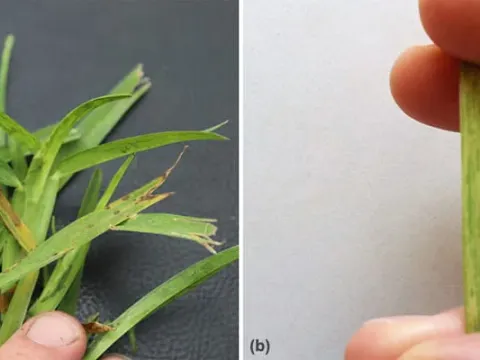
The initial symptoms include the development of chlorotic streaks and stripes on the leaves. These patterns run parallel to the leaf veins and often display a pale green or yellowish appearance.
As the infection progresses, these streaks may coalesce to form a mosaic pattern covering the entire leaf blade. Heavily infected plants show stunted growth and reduced tiller production, leading to sparse stands.
In advanced stages, the tips of the leaves may curl and exhibit premature necrosis. Severely affected plants lose their competitiveness, leading to their gradual disappearance from the sward.
Early diagnosis can be challenging as the symptoms might be mild or overlooked during rapid growth periods. Accurate identification often requires observation over time or laboratory diagnostics.
- Chlorotic striping along leaf veins.
- Mosaic patterning on leaf blades.
- Overall stunting and reduced biomass.
- Leaf tip curling and premature drying.
The distribution of RMV is strictly dependent on the environmental conditions that favor the proliferation of the mite vector Abacarus hystrix. Warm and dry weather facilitates rapid mite reproduction and movement.
Dense, intensely managed pastures provide an ideal microclimate for the vector to thrive. Higher plant density allows for easier migration of mites between host plants, accelerating the spread of the virus.
Proximity to weed-infested areas or old, unmanaged grass stands acts as a constant source of infection. These areas serve as biological bridges where the virus and its vector persist through the year.
In regions with mild winters, the virus is more likely to survive in living plant tissue, leading to a high infection pressure at the beginning of the spring growth cycle.
Mechanical damage during grazing or harvesting can occasionally facilitate localized spread, but the activity of the eriophyid mite remains the most significant driver of the infection cycle.
Ryegrass mosaic virus causes substantial economic losses by reducing both the yield and quality of forage. This impacts the overall feed value and the profitability of livestock operations.
The disease weakens plants, making them less resistant to environmental stresses such as frost or drought. Infected stands are prone to winterkill, which leads to thinning and degradation of the field.
The nutritional profile of infected grass is compromised, with lower sugar and protein content compared to healthy foliage. This decreases the overall energy availability for livestock grazing on these pastures.
Chronic infection often leads to a shift in the botanical composition of the field, where valuable ryegrass species are replaced by opportunistic weeds that are less susceptible to the virus.
Costs related to the need for early reseeding and lost forage production represent a significant burden. Effective disease management is essential for maintaining the productivity of agricultural grasslands.
The use of certified seed and the cultivation of resistant varieties are the primary methods of defense. Plant breeding programs continue to focus on enhancing genetic resistance to RMV.
Implementing proper crop rotation and avoiding the continuous monoculture of ryegrass helps to break the infection cycle. Timely plowing of old residues is also a critical sanitation step.
Managing weeds along the edges of fields and buffer zones reduces the habitat for the mite vector. Removing potential reservoirs is a fundamental component of integrated disease management.
Early mowing of affected stands can reduce mite populations and limit the spread of the virus to surrounding healthy plants. Maintaining optimal soil fertility supports plant health and natural vigor.
While chemical control of mites with acaricides is possible, it is rarely economically feasible for extensive forage production. Therefore, focusing on agronomic practices and spatial isolation is the recommended strategy.