
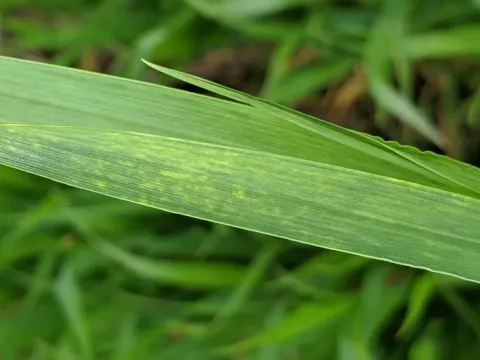
Wheat streak mosaic
Rymovirus agropyronis
The causal agent of this disease is the Wheat streak mosaic virus (WSMV), a member of the Rymovirus genus within the Potyviridae family. It is a plant virus characterized by filamentous particles containing single-stranded RNA.
What the section contains
Wheat streak mosaic
The virus is highly specialized, primarily affecting cereal crops and grasses. Its main reservoir in nature consists of wild grasses, particularly quackgrass (Elymus repens), which acts as a primary source of inoculum.
The virus does not spread mechanically via plant sap or through seeds. Instead, it relies entirely on a specific vector, the wheat curl mite (Aceria tosichella), for transmission and survival.
The mite acquires the virus while feeding on infected plant tissue and becomes a lifelong carrier. Once infected, the mite can transmit the virus to healthy plants for several weeks, ensuring the spread of the disease.
The incubation period within the host depends heavily on temperature and the physiological state of the crop. Once inside, the virus replicates and causes systemic infection, affecting all plant organs.
The first visual symptoms appear as light green or yellowish dashes and streaks on the leaves. Over time, these streaks merge to form a distinct mosaic pattern characteristic of the disease.
Infected plants show noticeable growth stunting and are significantly shorter than healthy neighbors. The infection often leads to poor tillering and an overall reduction in plant biomass.
In severe cases, leaf edges may curl and wither. On a field scale, the infection often manifests as irregular yellow patches that can expand to cover entire fields under favorable conditions.
The virus impacts reproductive organs, leading to spike sterility and deformed heads. Infected plants often produce shriveled, low-quality grain, significantly reducing yield and marketability.
Field diagnosis should be careful, as symptoms can resemble nitrogen deficiency or other mosaic viruses. Laboratory confirmation, such as ELISA or PCR, is recommended for definitive identification.
The primary factor for disease spread is the presence of quackgrass nearby, where the mite vector survives the winter. In spring, these mites migrate from grasses to emerging wheat crops.
Warm and dry weather conditions during spring and autumn favor mite reproduction and movement. Wind is the main carrier, blowing mites from infested areas to healthy cereal fields.
The presence of "green bridge" vegetation, such as volunteer wheat or grass weeds, is critical for disease cycles. It allows the virus to move continuously between crop generations.
Late-planted winter wheat is particularly susceptible as it emerges right when mite populations are peaking. Conversely, very early planting can also lead to fall infection, weakening the crop before winter.
Dense crop stands and poor rotation practices create an environment where the virus can accumulate. Epidemic outbreaks often occur when climatic conditions are optimal for both the mite and the virus.
The primary harm caused by Wheat streak mosaic is a dramatic reduction in photosynthetic efficiency, leading to significant yield losses. Infected crops struggle to reach their biological potential.
Yield losses can range from 30 to 70 percent, depending on the severity and timing of the infection. Plants infected early in the season suffer the most damage compared to those infected at later stages.
Grain quality is severely impacted, with reductions in test weight and milling properties. The resulting grain often fails to meet standard industrial requirements for baking and processing.
The disease significantly lowers winter hardiness in winter wheat crops. Infected plants often fail to survive the winter or emerge in spring in a severely weakened state, necessitating field replanting.
Because there is no cure for the virus once a plant is infected, the disease remains a major risk factor in global cereal production. Managing it requires long-term integrated pest management strategies.
The most critical control measure is the elimination of weed reservoirs, especially quackgrass. This should be performed on field borders, ditches, and adjacent lands throughout the growing season.
Strategic planting is essential to avoid peak mite migration periods. Adjusting sowing dates to avoid the synchronization of seedling emergence with mite activity can significantly reduce infection rates.
Farmers must prioritize the destruction of volunteer wheat after harvest. Eliminating this "green bridge" removes the source of the virus and the food supply for the mites.
There are no effective chemical sprays to treat the virus itself. Management focuses on mite control, though pesticide application is often impractical due to the mites' rapid dispersal and micro-habitat.
Developing and utilizing resistant or tolerant cultivars is the most sustainable approach to managing the disease. Breeding programs continue to focus on genetic resistance to mitigate the impact of this virus.