
Wheat streak mosaic virus
Emaravirus tritici
Description
Symptoms
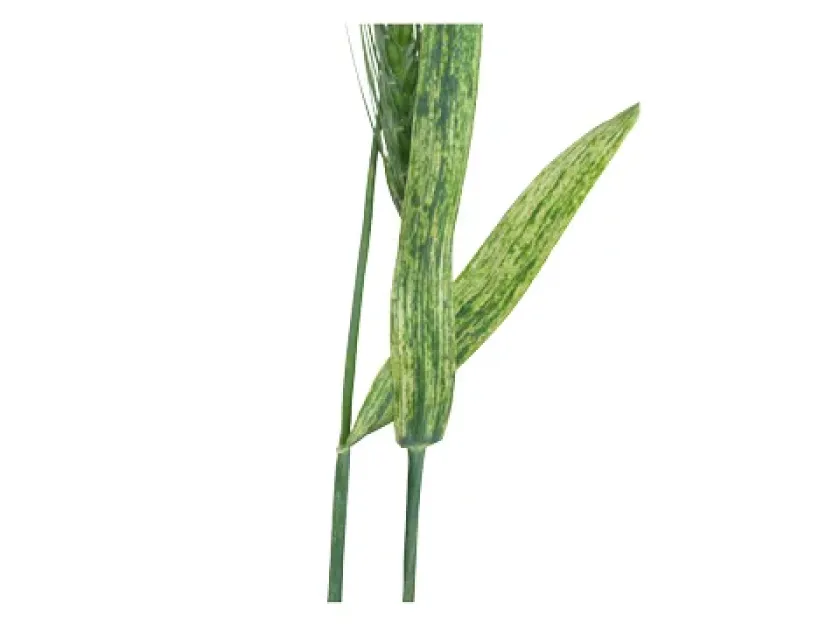
Symptoms typically begin with light green or yellow discontinuous streaks appearing parallel to the leaf veins. As the infection progresses, these streaks become more prominent and can lead to a mosaic-like discoloration.
Affected leaves often show characteristic twisting, curling, or rolling at the margins. Severely infected plants exhibit significant stunting, with shortened internodes and a generally diminished physical appearance compared to healthy plants.
Reduced tillering is a common sign, leading to a thin and sparse canopy. When plants are infected at an early seedling stage, they may fail to thrive, showing a stunted, rosetted growth pattern that significantly affects stand density.
As the disease develops, the mosaic symptoms spread to the flag leaf. The plant's overall photosynthetic area is reduced, which hinders the normal development of the vegetative biomass and limits yield potential.
In the reproductive stages, heads of infected plants often appear underdeveloped, sterile, or produce shriveled, low-weight grain. Total crop failure in specific sections of a field can occur under high infection pressure.
Pathogen
The causal agent of the disease is the Wheat streak mosaic virus (WSMV), which belongs to the Tritimovirus genus within the Potyviridae family. It is a single-stranded RNA virus known for its high adaptability and potential for rapid evolution.
The primary vector and reservoir for this virus is the wheat curl mite, Aceria tosichella (also known as Eriophyes tulipae). This microscopic pest is essential for transmitting the virus and sustains the disease cycle within agricultural landscapes.
The virus has a wide host range, infecting various cereal crops including wheat, barley, oats, maize, and millet. Additionally, numerous perennial grasses, such as quackgrass, act as natural reservoirs for the pathogen.
The virus persists in living plant tissues. Volunteer wheat plants that emerge after harvest serve as a critical "green bridge," allowing the virus and its mite vector to survive and transfer to newly planted winter wheat crops.
Seed transmission of WSMV is generally considered negligible. Consequently, the disease spreads primarily through the movement of viruliferous mites, which are carried by wind or move between adjacent plants.
Conditions for development
The spread of WSMV is highly dependent on the population dynamics of the wheat curl mite. Warm, dry weather conditions during late summer and early autumn favor the rapid multiplication and dispersal of the mites.
A mild and prolonged autumn provides an extended window for mites to migrate from volunteer wheat to newly emerged winter wheat. Early autumn infection is particularly damaging, leading to severe yield losses in the following season.
The presence of a "green bridge" is the most significant factor in disease epidemics. When volunteer wheat is left untreated near new winter wheat fields, the mite population quickly moves to the young, susceptible seedlings.
Wind is the primary mechanism for long-distance mite dispersal. Mites can be transported over significant distances, leading to widespread infection outbreaks across entire agricultural regions if not managed properly.
Moderate winter temperatures allow both the vector and the virus to survive in dormant plants, ensuring that the disease cycle resumes as soon as temperatures rise in the spring.
Why it matters
Wheat streak mosaic virus is one of the most damaging viral diseases of cereals. Yield losses can range from 10% to over 80%, depending on the timing of infection and the overall environmental stress on the crop.
Infected plants suffer from reduced cold tolerance, often resulting in high mortality rates during winter months. This leads to spotty or uneven crop stands that require expensive management decisions.
The quality of the harvested grain is significantly compromised. Lower grain test weight, reduced protein content, and poor flour quality make the produce undesirable for milling and baking purposes.
The virus disrupts the plant's metabolic processes, increasing its susceptibility to drought, nutrient deficiencies, and soil-borne pathogens. This systemic weakening makes it impossible for the crop to reach its genetic yield potential.
Economic damage is further compounded by the lack of direct chemical treatments for the virus, forcing farmers to rely entirely on preventative strategies which require careful field management and long-term planning.
Protection
The most effective strategy for managing WSMV is the elimination of the "green bridge." This involves destroying all volunteer wheat and grassy weeds in and around fields at least two weeks before planting new crops.
Maintaining adequate spatial separation between fields of different planting dates helps reduce the risk of mites moving from older, infested crops into younger, highly susceptible fields.
Adjusting planting dates is a recommended practice. Avoiding very early planting in areas with high mite pressure can prevent early-season colonization and minimize the incidence of the virus.
The selection and use of resistant or tolerant wheat varieties remain the most sustainable solution. Breeding programs focused on resistance to Aceria tosichella are crucial for long-term disease management.
Monitoring fields for mite infestations and adhering to strict agricultural sanitation practices are essential. Since there are no curative measures for the virus, preventing initial infection is the only way to safeguard the yield.
Discussion
No discussions yet — be the first.