
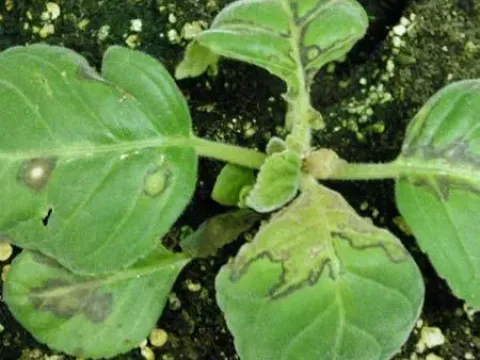
Impatiens necrotic spot virus
Potyvirus impatiensis
The Impatiens necrotic spot virus (INSV) is a member of the Orthotospovirus genus. It is a highly significant plant pathogen affecting a broad range of ornamental, vegetable, and weed species.
What the section contains
Impatiens necrotic spot virus
The virus is an enveloped, spherical particle containing a tripartite single-stranded RNA genome. Its high mutation rate allows it to adapt to various hosts, making management a continuous challenge for growers.
The primary vector for INSV is the western flower thrips (Frankliniella occidentalis). The virus is acquired by larvae during feeding and is transmitted persistently by adults throughout their lifespan.
Transmission occurs primarily through the movement of infected thrips within a greenhouse environment. Mechanical transmission through infected pruning tools or contaminated hands is also possible but less frequent.
The virus does not survive for long outside of a living host or its insect vector, which is a critical point to consider when implementing greenhouse sanitation protocols.
Symptoms of INSV are notoriously variable and can easily be confused with fungal diseases or nutrient deficiencies. Classic signs include necrotic ringspots and mosaic patterns on leaves.
Affected leaves often display chlorotic spots, streaks, or necrotic patches that may coalesce, leading to severe leaf blight and premature leaf drop.
Stem necrosis is a common symptom in impatiens, often appearing as localized dark streaks or sunken lesions that may eventually cause the entire shoot to wilt and collapse.
Floral symptoms are a major economic concern, as the virus causes distortions, irregular color breaking, and necrotic spotting on petals, rendering the flowers unsalable.
Systemic infection results in overall stunting, shortened internodes, and a rosette growth habit, significantly reducing the vigor and aesthetic appeal of the plant.
The development of the disease is inextricably linked to the population dynamics of the western flower thrips. Warm temperatures in greenhouses accelerate both the life cycle of the insect and the replication of the virus.
High humidity levels and overcrowding of plants provide an ideal environment for thrips to move between plants and spread the infection effectively.
The virus can persist in weeds surrounding the greenhouse, which act as a reservoir during the off-season. These weeds must be managed to prevent primary infections.
Spring and summer months typically see the highest incidence of the disease as thrips populations increase due to favorable environmental conditions.
Plants under stress are generally more susceptible to the symptoms of the virus, although healthy-looking plants can also carry and spread the infection if they are asymptomatic.
INSV is a major cause of economic loss in the horticultural industry worldwide. It affects not only impatiens but also many high-value greenhouse crops like cyclamen and petunias.
The disease is systemic, meaning there is no cure once a plant is infected. This necessitates the total destruction of symptomatic plants to protect the rest of the crop.
Even mild infections significantly decrease the market value of ornamental plants, as consumers reject plants with distorted or spotted foliage and flowers.
The management of INSV involves high costs related to insecticide application, increased labor for monitoring, and the potential loss of entire batches of inventory.
In mixed-crop greenhouses, INSV poses a risk to multiple different plant species, making it a critical threat to the overall diversity and profitability of the operation.
Integrated Pest Management (IPM) is the most effective approach for controlling INSV. The primary focus should be on the management of thrips populations using both chemical and biological tools.
Strict sanitation practices are required to prevent the introduction of the virus into the growing facility. This includes removing weeds from in and around the greenhouse.
- Monitor thrips populations using blue or yellow sticky traps distributed throughout the crop.
- Immediately rogue and destroy any plants suspected of having INSV symptoms.
- Implement rigorous sanitation for tools and workspaces to prevent mechanical spread.
- Quarantine all new plant material upon arrival to monitor for potential viral symptoms.
- Use professional diagnostic tests like ELISA or lateral flow immunoassays to confirm infections.
Biological control agents, such as predatory mites and nematodes targeting thrips larvae in the soil, should be integrated into the greenhouse management plan to reduce reliance on chemical sprays.