
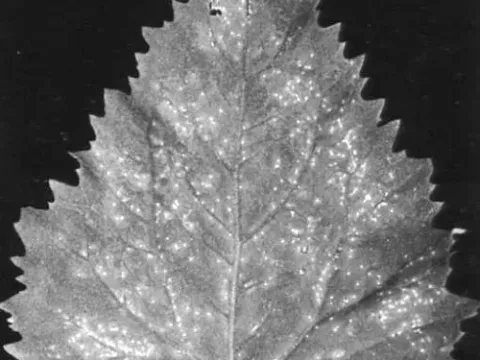
Carnation ringspot
Dianthovirus dianthi
The causal agent of this disease is the Carnation ringspot virus, classified under the name Dianthovirus dianthi. It belongs to the Tombusviridae family and is a significant pathogen for Dianthus species.
What the section contains
Carnation ringspot
The virus particles are small, spherical, and contain single-stranded RNA. It is a highly stable pathogen that can persist in dead plant tissue and within the soil environment for extended periods.
Transmission primarily occurs mechanically. The virus is easily spread through infected sap during routine greenhouse operations like pruning, cutting, or pinching if tools are not disinfected.
In addition to mechanical spread, the virus can persist in the soil and infect the root systems of healthy plants. It is often introduced into clean areas through contaminated substrate or root residues.
Soil-borne nematodes are also known vectors of this virus. They feed on infected roots and carry the virus to healthy plants, making it difficult to contain without proper soil sanitation.
Symptoms typically include the development of chlorotic spots on leaves. Over time, these spots often merge to form distinct concentric rings, lines, or mosaic patterns.
Infected carnation plants often display stunted growth, with shortened internodes and a generally dwarfed, bushy appearance that deviates from normal plant vigor.
Foliar deformation is common, with leaves appearing curled, yellowed, or showing signs of necrosis in advanced stages of the disease.
Flower production is severely impaired. Buds may fail to open or, if they do, they are often malformed, smaller than average, and lack the vibrant color characteristic of the variety.
The disease often spreads in patches within a greenhouse row, clearly demonstrating the role of physical contact and tool-mediated transmission in the spread of the virus.
Carnation ringspot causes substantial economic losses, particularly in commercial cut flower operations, as infected plants lose their marketability due to aesthetic defects.
There is no chemical cure for the virus once a plant is infected. Consequently, the standard practice is the complete removal and destruction of symptomatic plants to prevent further spread.
Propagation is a major risk factor. Using cuttings from infected mother plants ensures the perpetuation of the disease in subsequent crop cycles, leading to long-term issues.
The systemic nature of the viral infection compromises the plant's metabolic processes, reducing its overall resilience to environmental stress and other secondary pathogens.
Large-scale outbreaks can lead to total crop loss, necessitating costly sanitation programs and the replacement of entire plant stocks to restore healthy production.
The cornerstone of control is the use of virus-free planting material. Growers should source cuttings exclusively from certified nurseries that practice rigorous indexing and virus testing.
Strict sanitation protocols must be enforced in the greenhouse. Tools used for cutting or pruning must be disinfected between every single plant to eliminate the risk of sap-borne transmission.
Prompt roguing is essential; as soon as symptoms are identified, the infected plants and the surrounding soil should be removed and destroyed away from the production area.
Managing nematode populations in the soil is a vital preventative measure. Soil steaming or the use of approved nematicides can help break the cycle of viral transmission.
Maintaining a clean production environment, including the disinfection of pots, benches, and work surfaces, is critical to preventing the re-entry of the virus into the greenhouse.