
Tobacco yellow dwarf
Tobacco yellow
Description
Symptoms
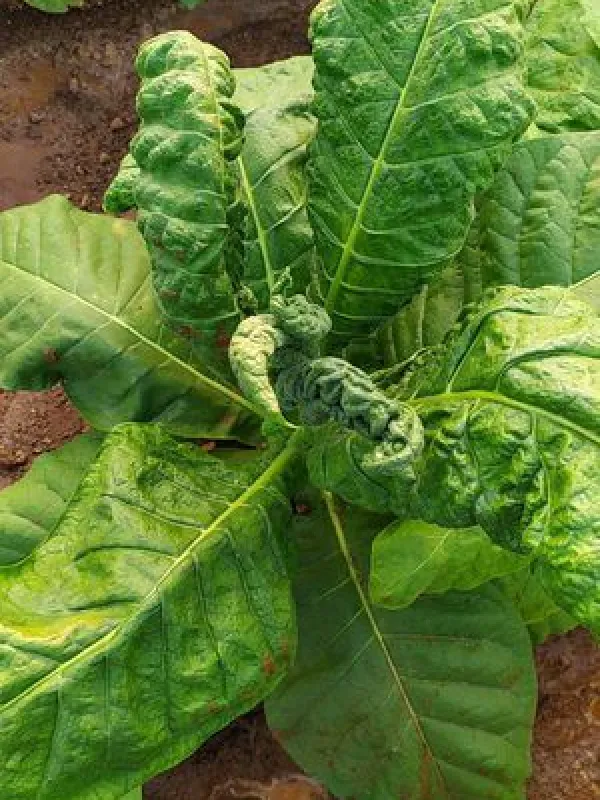
The initial signs of infection include the clearing of leaf veins in young foliage. This quickly transitions into a pronounced chlorotic mosaic or overall yellowing of the leaves.
True to its name, the disease causes severe curling. Leaves become distorted, with edges rolling inward or outward, and the leaf surface often develops a puckered or bumpy texture.
Plants affected during their early growth stage show severe stunting. Internodes are significantly shortened, resulting in a compact, bushy, and stunted appearance that deviates sharply from healthy growth.
Flowering is usually severely impacted. Flowers may become malformed or abort entirely. If seed pods develop, they are often of poor quality, and seeds show drastically reduced germination rates.
The root system of infected plants also fails to thrive, which limits the plant’s access to soil moisture and nutrients, further exacerbating the stress on the plant.
Pathogen
The Tobacco yellow dwarf virus (TYDV) is a member of the geminivirus family. This pathogen is a serious threat to tobacco production, causing severe physiological disturbances within the plant host.
As an obligate parasite, the virus requires a living host to replicate. It specifically colonizes the phloem tissue, which is responsible for the transport of sugars and nutrients throughout the tobacco plant.
The virus is exclusively transmitted by the leafhopper species Orosius argentatus. The insect acquires the virus while feeding on infected plants and maintains the ability to transmit it for the remainder of its lifespan.
Transmission occurs through the salivary glands of the leafhopper, which injects viral particles into the vascular system of healthy plants during feeding. The latent period before symptoms appear usually spans several weeks.
The virus does not spread through mechanical contact or sap contamination, emphasizing the critical role of vector management in controlling the spread of this disease.
Conditions for development
The development of the disease is strictly linked to the population dynamics of the leafhopper vector. Hot, arid conditions are most favorable for the rapid reproduction and movement of these insects.
Weed populations in the vicinity of tobacco fields often serve as viral reservoirs. These plants harbor the virus during the off-season, providing a persistent source of inoculum for subsequent crops.
Vector migration is often triggered when wild vegetation dries out, forcing the leafhoppers to search for more succulent plant material, such as tobacco crops.
Monoculture practices and the lack of crop rotation contribute to the buildup of virus-carrying leafhopper populations over consecutive years in the same geographic area.
High temperatures (typically between 25°C and 30°C) are optimal for the multiplication of the leafhopper, significantly increasing the probability of widespread infection throughout the field.
Why it matters
The damage caused by Tobacco yellow dwarf is primarily reflected in severe yield losses and the total degradation of leaf quality. Infected tobacco is generally unsuitable for commercial processing.
The chemical changes within the leaf induced by the virus destroy the desirable aromatic and smoking qualities expected in quality tobacco, making the harvest economically worthless.
Yield reductions can be dramatic, with some fields experiencing losses of up to 80% if the vector population is high and early management is neglected.
Secondary infections are common, as the stressed plants are unable to effectively fend off opportunistic pathogens, further complicating the field's health status.
The necessity for ongoing insecticidal treatments to control the vectors increases production costs and may negatively impact the environmental balance of the farm.
Protection
Integrated pest management (IPM) is the most effective approach, focusing primarily on the elimination of weed reservoirs surrounding the fields to reduce initial viral pressure.
Systemic insecticides are essential for controlling leafhopper populations, especially in the early stages of the crop cycle to prevent primary infections.
Spatial isolation between new plantings and older tobacco or host-plant fields is recommended to minimize the risk of vector migration from infested areas.
Selection of resistant or tolerant cultivars is a long-term strategy that provides the best protection against viral impacts without excessive chemical reliance.
- Regular monitoring of leafhopper populations using yellow sticky traps.
- Implementing strict crop rotation schedules.
- Rogueing (removing) infected plants immediately upon discovery to limit local spread.
- Timing planting to avoid the peak seasonal activity of the vector.
Discussion
No discussions yet — be the first.