
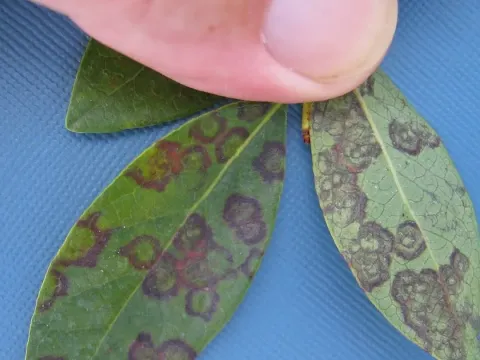
Blueberry calico virus
Ilarvirus bcrv
The primary symptom of the Blueberry Calico Virus (BCRV) is the development of specific chlorotic spots on the leaves. These spots frequently appear as rings, semi-circles, or line patterns, which gives the disease its characteristic appearance.
What the section contains
Blueberry calico virus
At the beginning of the growing season, symptoms often manifest as bright yellow coloration (calico) on specific parts of the leaf blade. As leaves mature, these chlorotic areas may fade or progress to tissue necrosis, depending on the viral strain.
The virus affects not only the foliage but can also lead to stunted shoot development. Some cultivars exhibit few to no visible symptoms, effectively acting as asymptomatic carriers of the infection.
During the fruiting season, symptoms may become more pronounced due to the physiological stress placed on the plant. While direct symptoms on fruit are rare, the overall vigor and health of the infected shrub decline significantly.
It is important to note that visual diagnostics can be challenging, as these symptoms are often confused with nutrient deficiencies or other physiological disorders.
The pathogen responsible for the disease is the Blueberry Calico Virus, a member of the genus Ilarvirus (Ilarvirus bcrv). It is a single-stranded RNA virus primarily spread through infected propagation material.
The virus's biology is deeply linked to the plant's vascular system. As a systemic pathogen, it colonizes all tissues, including the meristems, which makes the virus particularly dangerous in nursery settings.
The virus is capable of persistent infection in highbush blueberries and wild blueberry species. It does not kill the shrub instantly but causes a gradual decline in productivity over many years.
Transmission occurs primarily through vegetative propagation, such as cuttings, grafting, and division of established shrubs. While natural transmission via insect vectors or nematodes in field conditions is not fully documented, it remains a potential risk factor.
Genetic diversity among viral strains can lead to significant variations in symptoms, necessitating molecular laboratory diagnostics to confirm the presence of the virus.
Viral development within the host plant occurs continuously, though symptom expression usually peaks during the spring and early summer. Active sap flow during these months facilitates the rapid movement of viral particles.
Temperature plays a vital role in disease manifestation: moderately warm conditions are generally conducive to high viral titers. In contrast, extreme heat may temporarily mask the visual symptoms on the foliage.
Mechanical damage to shrubs during pruning is a major risk factor in commercial orchards. The use of non-sterilized pruning shears and saws allows for easy viral spread from one plant to another.
The presence of weeds, which may serve as alternative hosts or harbor potential vectors like insects, increases the risk of secondary infections for neighboring healthy plants.
Planting in areas where previously infected berry crops were grown poses a risk, as the soil might harbor nematodes that act as transmission vectors for similar viruses.
The primary economic impact of the virus is a significant reduction in plantation productivity. Infected shrubs exhibit reduced vigor, which directly leads to lower fruit yields and smaller berry size.
Fruit quality on infected plants often declines, with poorer flavor profiles. Because the virus reduces the photosynthetic activity of the leaves, the plant struggles to accumulate necessary sugars and nutrients in its roots.
BCRV-infected plants show decreased winter hardiness. These shrubs are more susceptible to winter frost damage and spring cold snaps compared to their healthy counterparts.
Infected planting material serves as a primary source of disease spread to new locations. Using uncertified nursery stock almost guarantees the spread of the virus across a new orchard within a few years.
Economic losses include the cost of removing and replacing entire sectors of the plantation, as well as the long-term investment required to secure disease-free certified stock.
The cornerstone of management is the exclusive use of healthy, certified propagation material. Only purchasing plants from reputable nurseries can guarantee the absence of the virus.
Regular phytosanitary monitoring of the orchard is essential. Any shrub showing symptoms of calico or other viral signs should be immediately removed and destroyed, preferably burned, to prevent further spread.
Strict hygiene protocols during pruning and other maintenance work are mandatory. All tools must be disinfected between shrubs using alcohol or sodium hypochlorite solutions to prevent cross-contamination.
Managing insect pests and soil nematodes, which potentially serve as vectors, is a critical component of a comprehensive orchard health strategy.
Balanced fertilization and optimal irrigation help the plant cope with virus-induced stress; however, it is important to understand that there is currently no chemical treatment capable of curing an infected plant.