
Blueberry scorch virus
Carlavirus vaccinii
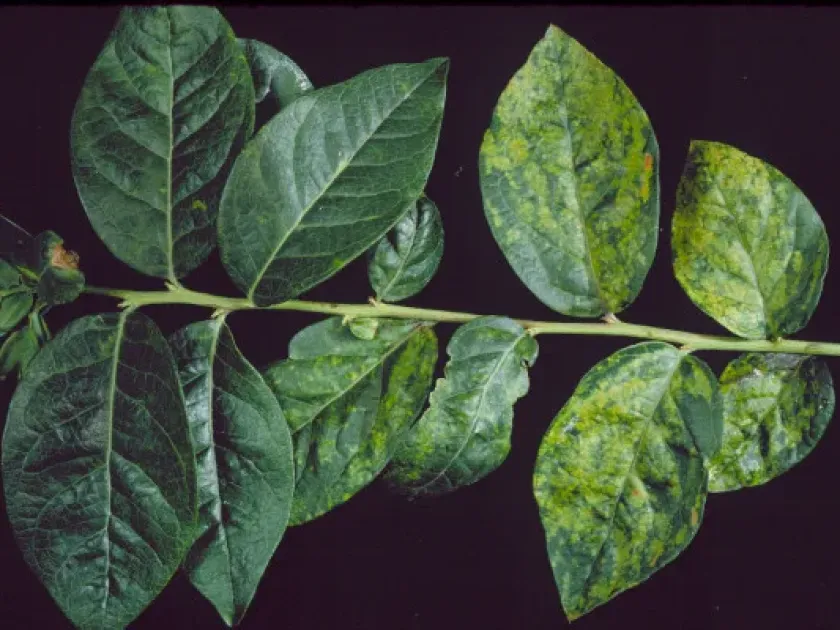
Description
Symptoms
The most distinctive sign of BlScV is the sudden necrosis of flowers and young leaves in spring, creating the appearance of scorched foliage, which is the origin of the disease's name.
Leaves may exhibit chlorotic patterns, mosaic symptoms, or marginal necrosis. These symptoms are often more severe in the spring and may appear to fade as the season progresses.
Infected bushes often show reduced vigor, stunted growth, and a significant decrease in the number of new shoots being produced each season.
Some cultivars may remain symptomless for years, serving as hidden reservoirs that spread the virus to more susceptible neighboring plants through aphid activity.
- Springtime necrosis of flowers and leaves.
- Yellowing or chlorosis of the foliage.
- Reduced fruit set and stunted growth.
- Premature leaf drop in severe cases.
Pathogen
The causal agent is the Blueberry scorch virus (BlScV), which is a member of the Carlavirus genus. It is an RNA virus that systemically infects host plants.
The virus is primarily transmitted by aphids, which act as vectors, moving the virus from infected plants to healthy ones during the feeding process.
It infects various Vaccinium species, with highbush blueberry being particularly susceptible. The virus spreads through the plant's vascular system, disrupting normal physiological functions.
BlScV is a significant concern for international trade, often listed as a quarantine pest in many countries to prevent its introduction into new growing regions.
Because the virus remains in the plant for its entire lifespan, it is considered a permanent infection, making early detection and removal the only effective management strategy.
Conditions for development
The spread of BlScV is closely linked to the lifecycle and migration patterns of its aphid vectors, which are most active during the early spring bloom period.
Environmental factors that favor high aphid populations, such as mild winters and humid springs, significantly increase the rate of virus transmission within a field.
Human activity is a major cause of spread, especially through the transport of infected nursery stock. Vegetative propagation materials that are not virus-tested are high-risk vectors.
Nearby abandoned blueberry fields or wild Vaccinium populations can act as environmental reservoirs, allowing aphids to pick up the virus and bring it into commercial production sites.
Plant density plays a role in transmission rates; closer spacing between bushes facilitates the movement of insect vectors and accelerates the formation of infection clusters.
Why it matters
The primary damage is a severe reduction in fruit yield. Since the virus causes blossom blight, infected bushes often fail to produce a marketable crop.
Chronic infection weakens the overall health of the plant, leading to poor vegetative growth, reduced photosynthetic capability, and eventually the death of the bush.
Economic losses arise not only from low yields but also from the necessity of removing and destroying symptomatic bushes, which reduces the overall density of the plantation.
Fruit quality is also severely compromised, with remaining berries often showing poor size and taste, which damages the reputation of the grower and market potential.
Outbreaks can lead to regulatory action, including the quarantine of the farm, preventing the sale of plants or berries and causing long-term financial damage to the business.
Protection
The most important control strategy is the use of virus-indexed, certified nursery stock. Never propagate plants from fields where the virus has been detected.
Implement an aggressive aphid management program using registered insecticides during the peak activity periods to minimize the vector population in the field.
Routinely inspect plantations for symptoms, especially during the spring bloom. If symptomatic bushes are identified, they should be rogued out and destroyed immediately.
Ensure that all pruning tools are properly disinfected between bushes to prevent mechanical transmission of the virus, although aphids remain the primary concern.
Maintain a clean field environment by removing weeds and wild Vaccinium hosts that may harbor aphids or serve as a source of the virus, creating a buffer zone.
Discussion
No discussions yet — be the first.