
Blackcurrant yellows
Blackcurrant yellows
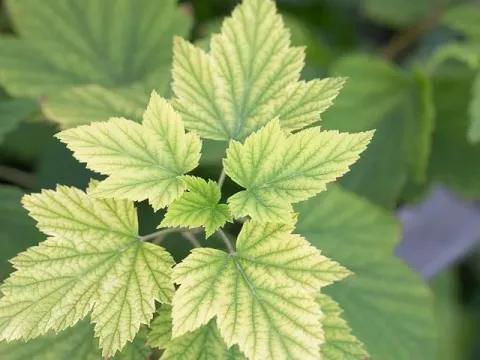
The primary external sign of the disease is characteristic yellowing of the leaves, which often begins at the leaf margins or along the main veins. Over time, chlorosis spreads across the entire leaf, giving the bush an unhealthy, sickly appearance.
What the section contains
Blackcurrant yellows
Affected plants show stunted leaf growth, with leaves becoming wrinkled and losing their natural glossy luster. In some cases, the leaf edges may curl inward, which deforms the overall shape of the shoots.
Significant suppression of the bush's overall growth is observed: internodes become shortened, and branches become weak and thin. The plant stops actively producing vegetative mass, leading to premature lignification of young shoots.
Flower clusters in plants affected by yellows are often underdeveloped, and the flowers may exhibit abnormal coloration or structural deformities. Fruits on affected branches set poorly, often dropping before full maturity, and the remaining berries have extremely poor flavor quality.
In advanced stages, the disease causes dieback of shoot tips and gradual death of the entire above-ground part of the bush. A diseased plant cannot be cured and becomes a permanent source of infection for neighboring bushes in the garden.
The pathogen responsible for blackcurrant yellows is a mycoplasma-like organism (phytoplasma) that infects the plant's vascular system. Unlike fungal infections, the pathogen resides directly in the phloem, disrupting the transport of nutrients.
Phytoplasmas are specialized parasites that cannot exist outside the host plant's cells or the insect vector. They have an extremely small size and lack a cell wall, which makes them difficult to detect using standard microscopic methods.
The infection spreads systemically through the plant's vascular network, which is why isolated pruning of affected branches rarely yields a positive result. The pathogen completely alters the plant's metabolism, forcing it to expend resources on maintaining the pathological process.
This disease belongs to the group of yellows diseases, which share a similar mechanism of affecting plant organisms. The pathogen does not survive in soil or on fallen leaves, as it requires a living host to maintain its lifecycle.
Transmission in natural conditions occurs primarily through insect vectors, such as leafhoppers, which feed on the sap of diseased plants and then move to healthy ones. The infection is also spread through vegetative propagation via infected cuttings and nursery stock.
The spread of the disease is directly linked to the activity of insect vectors, which peaks during warm and humid periods of the growing season. In years with high leafhopper populations, the risk of an epidemic increases significantly.
Overcrowded plantings and lack of proper agrotechnical practices create a favorable microclimate for pest multiplication. In poorly ventilated areas, insect vectors move more rapidly between bushes, spreading the pathogen efficiently.
Infection often occurs in nurseries, where cuttings from mother plants with latent (hidden) infection are used for propagation. The first symptoms may only appear a year after the sapling has been planted in its permanent location.
Imbalanced plant nutrition, especially an excess of nitrogen fertilizers, promotes rapid growth of succulent tissue, which is more attractive to sap-sucking insects. Weakened immunity due to micronutrient deficiency reduces the plant's resistance to viral and phytoplasma agents.
Weather factors, such as prolonged rains or abnormal heat, can indirectly influence the disease's development by changing the migration timing of insects. However, the main factor in its spread remains the presence of a primary infection source within the reach of vectors.
The main danger of blackcurrant yellows lies in the impossibility of curing an affected bush, which inevitably leads to its death. The plant gradually loses its productivity, becoming economically useless for the gardener.
The presence of infection on a plot poses a threat to the entire berry patch, as insects quickly carry the pathogen from diseased plants to healthy ones. Without the timely removal of infected bushes, an entire currant plantation can be lost.
The quality of the harvest drops to critical levels: berries become small, sour, and lose their marketability. Even if the plant continues to fruit, the yield decreases tenfold compared to healthy specimens.
The disease leads to a general weakening of the currant's immunity, making it more susceptible to other diseases and pests. As a result, the bush becomes a reservoir for pathogens that may affect other crops in the garden.
The economic damage consists of the costs of uprooting diseased plants, the price of new saplings, and the loss of harvest over several years. Prevention is economically much more profitable than dealing with the consequences of its spread.
The primary method of control is strict adherence to phytosanitary measures: regular inspection of plantings and immediate removal of infected bushes with the root ball. Removed plants must be burned outside the garden area.
When establishing new plantations, it is crucial to use only certified planting material from reputable nurseries. Never take cuttings from bushes that show signs of chlorosis or abnormal leaf deformation.
Controlling insect vectors is a key link in protection. Regular insecticide treatments are necessary during leafhopper migration periods to break the chain of infection transmission from diseased to healthy plants.
Agrotechnical measures include maintaining cleanliness in row spacings and timely weeding, as weeds can serve as temporary hosts for the pathogen or shelters for insects. Maintaining optimal plant density improves the ventilation of the bushes.
The use of immunomodulators and proper agrotechnical practices (balanced nutrition, watering) help the plant better withstand stress factors. Although there are no specific chemical treatments for phytoplasma, a healthy bush maintains its productivity for longer.