
Blueberry blunervirus
Blunervirus vaccinii
Description
Symptoms
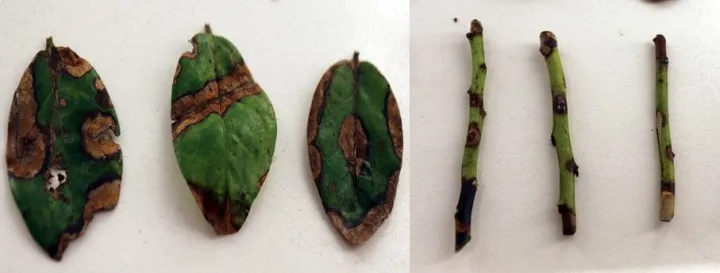
Symptomatology of blueberry blunervirus often manifests as distinct chlorotic spotting on leaves, which may develop into ring patterns. These signs are frequently accompanied by leaf deformation, curling, and the twisting of younger shoots during the active growth phase.
Infected bushes often exhibit premature discoloration, with foliage turning yellow or red during the summer. As the infection progresses, the plant's physiological stress becomes evident through diminished vigor, reduced shoot elongation, and overall stunting of the plant.
A notable reproductive impact is observed during the fruiting stage, where berries become significantly smaller, show uneven ripening, and suffer from poor sugar accumulation. This severely degrades the marketability and yield of the harvest.
Sometimes, hormonal imbalance induced by the virus leads to abnormal proliferation of branches, known as "witches' broom" structures. This excessive and disordered growth depletes the plant's energy reserves, making it susceptible to further environmental stress.
Diagnosis in the field is difficult because symptoms often mimic those of nutritional deficiencies or other abiotic stresses. Molecular testing, such as RT-PCR, remains the only reliable method to confirm the presence of the virus in suspected samples.
- Chlorotic spots and necrotic rings on leaves
- Distorted, curled, or twisted foliage
- Stunted growth and reduced vigor
- Small, poorly ripened, and low-quality berries
- Abnormal branch proliferation (witches' broom)
Pathogen
Blueberry blunervirus (Blunervirus vaccinii) is a viral plant pathogen that primarily targets species within the Ericaceae family. As a segmented RNA virus, it spreads systemically throughout the plant's vascular tissues, severely disrupting nutrient transport and metabolic processes.
The virus is highly host-specific, often circulating within wild populations of blueberries and bilberries before being transmitted to cultivated fields. Because the infection can remain latent, asymptomatic plants often serve as stealthy reservoirs for the virus.
In commercial agriculture, transmission is primarily mediated by insect vectors, specifically leafhoppers and other sap-sucking insects. As these pests feed on infected tissues, they acquire viral particles and introduce them into healthy plants during subsequent feeding events.
Mechanical transmission is another critical pathway. Garden tools, such as pruning shears and harvesting equipment, can harbor the virus in plant sap. If not disinfected between plants, these tools facilitate the rapid spread of the pathogen throughout a field.
The biological complexity of Blunervirus vaccinii makes it a challenging pathogen to manage. Its ability to reside in long-lived perennial tissues means that once a bush is infected, it remains a permanent source of inoculum until it is completely removed.
Conditions for development
The spread of blunervirus is highly dependent on the activity of insect vectors. Warm, humid weather patterns correlate with population surges of leafhoppers, which significantly increases the rate of virus transmission across the blueberry field.
Plants under physiological stress are particularly vulnerable. Factors such as soil pH imbalances, insufficient moisture, or improper fertilization weaken the plant's innate immunity, allowing the virus to establish and proliferate more aggressively.
Springtime represents the highest risk period, as the rapid growth of succulent, tender shoots makes them highly attractive to insects. During this stage, the virus can quickly move from localized infection points to the entire plant structure.
Poor orchard hygiene, such as dense planting without adequate airflow, creates an ideal microclimate for vectors to move freely between bushes. Furthermore, the presence of wild blueberry or weed species near the field can act as an external reservoir for the virus.
The use of infected nursery stock is the primary cause of long-distance pathogen dispersal. Because the virus can be latent, growers may inadvertently introduce the infection into clean fields, where it can spread slowly but surely over several seasons.
Why it matters
Blueberry blunervirus poses a significant threat to the economic viability of berry farms. Infected bushes see a steady decline in productivity, leading to cumulative yield losses that can render an entire field unprofitable within a few years.
Beyond yield reduction, the virus compromises the plant's cold hardiness. Infected bushes often suffer from winter injury more severely than healthy ones, which can lead to the total death of the crop in regions with harsh or unpredictable climates.
There is no chemical cure for this viral infection. Once established, the virus cannot be eradicated by fungicides or antivirals. This necessitates the destruction of infected plants to prevent the further spread of the pathogen, which adds to the cost of maintenance.
Maintaining a healthy crop requires additional investment in pest monitoring, laboratory testing, and nursery stock verification. These indirect costs significantly impact the operational budget and overall profit margins for the agricultural business.
The persistent nature of the virus creates a permanent phytosanitary risk. If unchecked, the virus can destroy valuable breeding lines or commercial cultivars, necessitating complete field sanitation and long-term fallow periods to interrupt the disease cycle.
Protection
Prevention is the most effective control strategy. Growers should strictly source planting material from reputable, certified nurseries that utilize rigorous virus-testing protocols to ensure that all new stock is free from Blunervirus vaccinii.
Systematic monitoring and control of insect vectors are essential. The timely application of approved insecticides during peak vector activity periods helps to limit the movement of the virus between plants and maintains the orchard's health.
Orchard hygiene is of paramount importance. Pruning tools must be thoroughly disinfected with appropriate solutions (such as bleach or specialized virucidal agents) between every individual bush to prevent the mechanical transmission of the virus.
If an infected bush is identified, it must be removed immediately, including its root system. Burning the infected material outside the field prevents the virus from surviving in decaying organic matter and lowers the overall inoculum pressure on the site.
Providing optimal growing conditions through precision fertilization and irrigation helps maintain plant vigor. Robust, well-nourished plants are generally more resilient and better equipped to manage the physiological impact of any potential exposure to pathogens.
Discussion
No discussions yet — be the first.