
Oat fijivirus
Fijivirus avenae
The causative agent is a virus belonging to the Fijivirus genus within the Reoviridae family. It features a segmented genome composed of double-stranded RNA.
What the section contains
Oat fijivirus
The virus relies on specific insect vectors, mainly planthoppers or leafhoppers. Transmission is circulative, meaning the virus replicates within the insect before being passed to the plant.
Due to the virus's ability to persist in the vector throughout its life, insects serve as both carriers and long-term reservoirs for the pathogen.
Oat fijivirus exhibits a wide host range, infecting various cereals including oats, wheat, and barley, as well as many wild grass species which harbor the virus.
Primary transmission occurs when infected insects feed on the sap of young, developing oat plants, introducing the viral particles directly into the phloem.
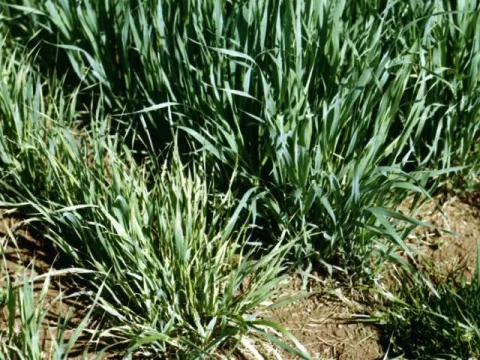
Initial symptoms include chlorotic spotting and striping on the leaves, which often develop into more intense yellow or pale streaks as the disease progresses.
Severe stunting is a hallmark of the infection; affected oat plants grow significantly slower and appear much smaller than their healthy counterparts in the same field.
Generative organs are frequently malformed. Panicles may become severely underdeveloped, often failing to emerge fully from the leaf sheath, which prevents proper grain filling.
The root system is usually compromised, leading to poor nutrient and water uptake, which makes the plant more susceptible to environmental stress.
On a field scale, infected areas show irregular growth patterns, increased patchiness, and a noticeably reduced density due to the loss of weak or dying plants.
Disease prevalence is heavily linked to the population dynamics of the insect vectors. Warm, humid springs typically trigger population surges in leafhoppers.
The presence of wild grasses near agricultural fields serves as a primary source of the virus, facilitating the movement of vectors into commercial crops.
Poor agricultural practices, such as failing to manage weeds during the early growing season, provide a bridge for the virus to move onto the oat crop.
Dense, poorly ventilated crop stands create a microclimate that favors vector movement and extended feeding periods, increasing the transmission rate.
Optimal viral spread occurs when environmental temperatures support both high insect activity and rapid plant colonization, particularly in the seedling stage.
The economic impact of Oat fijivirus is substantial, often resulting in significant yield losses due to stunted growth and reduced grain formation.
Infected plants suffer from impaired photosynthetic activity, leading to lower grain weight, poor grain quality, and reduced overall nutritional value of the harvest.
The disease causes systemic physiological collapse in affected plants, rendering them unable to achieve their full genetic yield potential.
Secondary infections, such as root rots, often occur because the viral stress weakens the plant's natural defense mechanisms, further reducing total yield.
In severe infestation cases, the reduction in crop uniformity and harvestable biomass can make fields economically unviable, necessitating replanting.
Effective control requires a multi-faceted approach centered on eradicating host reservoirs, specifically controlling weeds on field borders and nearby wild grass patches.
Systemic insecticides applied during the early vegetative stages are crucial for reducing the vector population and limiting the initial spread of the virus.
Careful crop rotation and adjusting sowing dates can help avoid the periods of peak insect migration, significantly reducing the chances of early-season infection.
Breeding and utilizing virus-resistant cultivars remains the most sustainable and efficient strategy for managing Oat fijivirus in large-scale agriculture.
- Spatial isolation from infected grasses.
- Monitoring vector activity using yellow sticky traps.
- Ensuring healthy, pathogen-free seed sourcing.
- Maintaining optimal field hygiene to reduce vector habitats.