
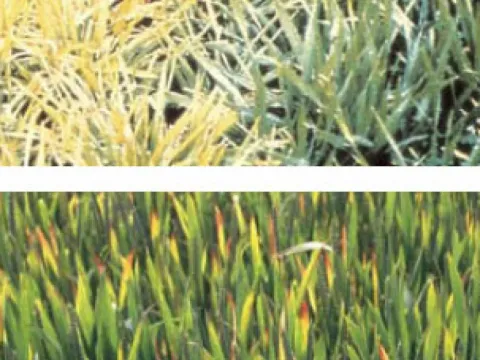
Oat red leaf
Oat red
The causative agent of this disease is the Barley yellow dwarf virus (BYDV), which is recognized as one of the most widespread and damaging viral pathogens affecting cereal crops globally.
What the section contains
Oat red leaf
The virus consists of single-stranded RNA particles. It does not spread mechanically through sap or seeds but relies entirely on insect vectors for transmission to healthy plants.
Various species of cereal aphids, including the bird cherry-oat aphid and the English grain aphid, serve as the primary vectors responsible for carrying and spreading the virus.
The virus circulates within the aphid's body, allowing the insect to remain infectious for the duration of its life after feeding on a symptomatic plant.
Different strains of the virus exhibit specific preferences for certain aphid species, which influences the distribution and intensity of the disease in various agricultural landscapes.
A classic symptom of this disease in oats is the development of a distinct reddish or orange discoloration, usually starting at the leaf tips and margins.
The coloration gradually progresses downwards, causing the leaves to become stiff and upright, which is a hallmark visual diagnostic feature for agronomists.
Infected plants exhibit severe stunting and reduced tiller numbers, giving them a compact, rosette-like appearance compared to healthy, vigorous plants in the same field.
Root system development is significantly impaired, leading to a diminished capacity for the plant to absorb essential water and nutrients during the growing season.
Heading and flowering in affected plants are often delayed, asynchronous, or fail to occur entirely, which results in significant direct yield losses.
The prevalence and spread of the disease are highly dependent on the population density of aphids during the early vegetative stages of the oat crop.
Cool and humid weather conditions are particularly favorable for the development of aphid populations, facilitating faster and more widespread viral transmission.
Perennial grasses located near cultivated fields act as crucial reservoirs for the virus, allowing it to survive during the winter months and spread to new crops in spring.
Early-sown crops are often at higher risk because their young, succulent tissues are highly attractive to migrating winged aphids during the peak spring migration period.
The formation of infection foci typically begins at field edges, where aphids congregate after moving from surrounding weed hosts or neighboring pasture areas.
The primary damage caused by oat red leaf virus is a significant reduction in grain yield, which can vary from 20% to nearly 80% depending on the timing of infection.
Infected plants produce fewer and smaller grains, often resulting in lower test weights and reduced quality that may not meet market standards for milling or seed usage.
The viral infection weakens the plant's physiological resilience, making it more susceptible to secondary stressors such as drought, nutrient deficiency, or fungal infections.
Beyond grain yield loss, the nutritive value of straw and green forage is often decreased, impacting livestock producers who rely on cereal crops for fodder.
Severe infestations can render entire fields non-productive, forcing farmers to harvest the crop prematurely for silage or abandon the field entirely due to lack of grain.
Integrated management is essential, focusing primarily on controlling aphid populations through the timely application of systemic or contact insecticides during peak migration.
Agronomic practices, such as controlling grassy weeds around field margins, are vital to eliminating the primary virus reservoirs and reducing the initial aphid population pressure.
Careful adjustment of planting dates can help the crop bypass the peak migration window of aphids, reducing the chances of early-season infection.
Selecting and planting tolerant or resistant oat varieties remains the most effective and sustainable strategy to mitigate the impact of the virus in endemic areas.
- Use yellow sticky traps to monitor aphid migration patterns and timing.
- Apply insecticidal seed treatments to provide protection for emerging seedlings.
- Ensure spatial isolation between new cereal plantings and established perennial grass fields.