
Oat mosaic virus
Tritimovirus avenae
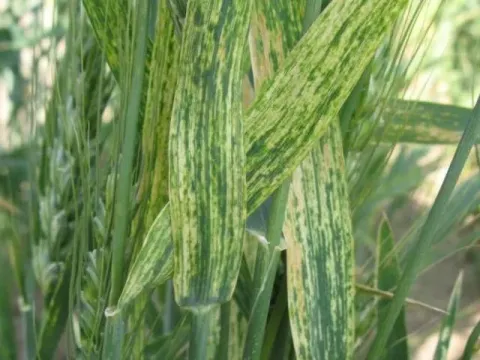
The primary symptom of oat mosaic virus is the development of intermittent light green or yellow streaks and patches along the leaf veins, giving the foliage a mottled appearance.
What the section contains
Oat mosaic virus
Infected plants exhibit stunted growth, characterized by shortened internodes and a reduced number of tillers, which prevents the crop from reaching its full potential.
Early-stage infection often leads to leaf curling or crinkling, as the virus interferes with normal cellular growth and leaf development during the vegetative phase.
During the tillering stage, infected fields appear uneven and chlorotic, with the severity of symptoms depending heavily on the timing of the initial viral attack.
As the plant matures, the production of heads (panicles) is often limited, resulting in poorly filled or completely empty grain heads, which drastically lowers overall yield.
The disease is caused by the Oat mosaic virus (OMV), which is a member of the genus Tritimovirus within the family Potyviridae.
The viral particle is filamentous and carries a single-stranded RNA genome, allowing it to efficiently replicate and systemically move through the plant tissues.
OMV is obligately transmitted by the soil-borne fungus Polymyxa graminis, an organism that inhabits the root systems of various cereal crops and grasses.
The virus persists within the resting spores (cystosori) of the fungus, which can remain viable in the soil for many years, surviving harsh environmental conditions.
Infection is initiated when zoospores of the fungus come into contact with oat roots and introduce the viral particles into the plant cells.
Development of the disease is highly dependent on soil moisture levels, as high soil humidity is necessary for the movement of fungal zoospores to the host roots.
Cooler temperatures, typically experienced during autumn or spring, favor both the activity of the fungal vector and the viral infection process.
Continuous cropping of susceptible oat varieties on the same land creates an ideal environment for the buildup of both the virus and the Polymyxa graminis vector.
The movement of soil particles via farm machinery represents a major risk for spreading the fungus and the associated virus to previously uninfected areas.
Soil structure and drainage play a significant role, as fields with poor drainage are more prone to prolonged moisture, which facilitates the transmission cycle.
The main impact of the virus is a significant reduction in grain yield and quality, as the plant's photosynthetic capacity is severely impaired.
Infected crops are significantly more susceptible to environmental stresses such as drought or frost, often leading to total crop failure in extreme cases.
The grain harvested from infected fields is often of low weight and poor nutritional value, making it unsuitable for commercial milling or seed production.
General plant vigor is reduced, which negatively impacts the crop's ability to compete with weeds and respond effectively to standard fertilizer applications.
Financial losses for farmers are substantial due to the combination of reduced yield and the need for costly field sanitation or potential land decontamination measures.
The most effective management strategy is the use of resistant or tolerant cultivars, which prevent the virus from causing severe damage even if present in the soil.
Implementing long-term crop rotation schemes helps break the life cycle of the fungal vector by denying it a suitable host for an extended period.
Improving field drainage through proper land management practices can reduce the conditions that favor the activity of the fungal zoospores in the soil.
Strict sanitation of agricultural equipment is essential to prevent the transfer of pathogen-carrying soil from infested fields to clean production areas.
Integrated weed management is recommended, as many wild grasses can act as alternative hosts for both the virus and the fungal vector, sustaining the inoculum source.